
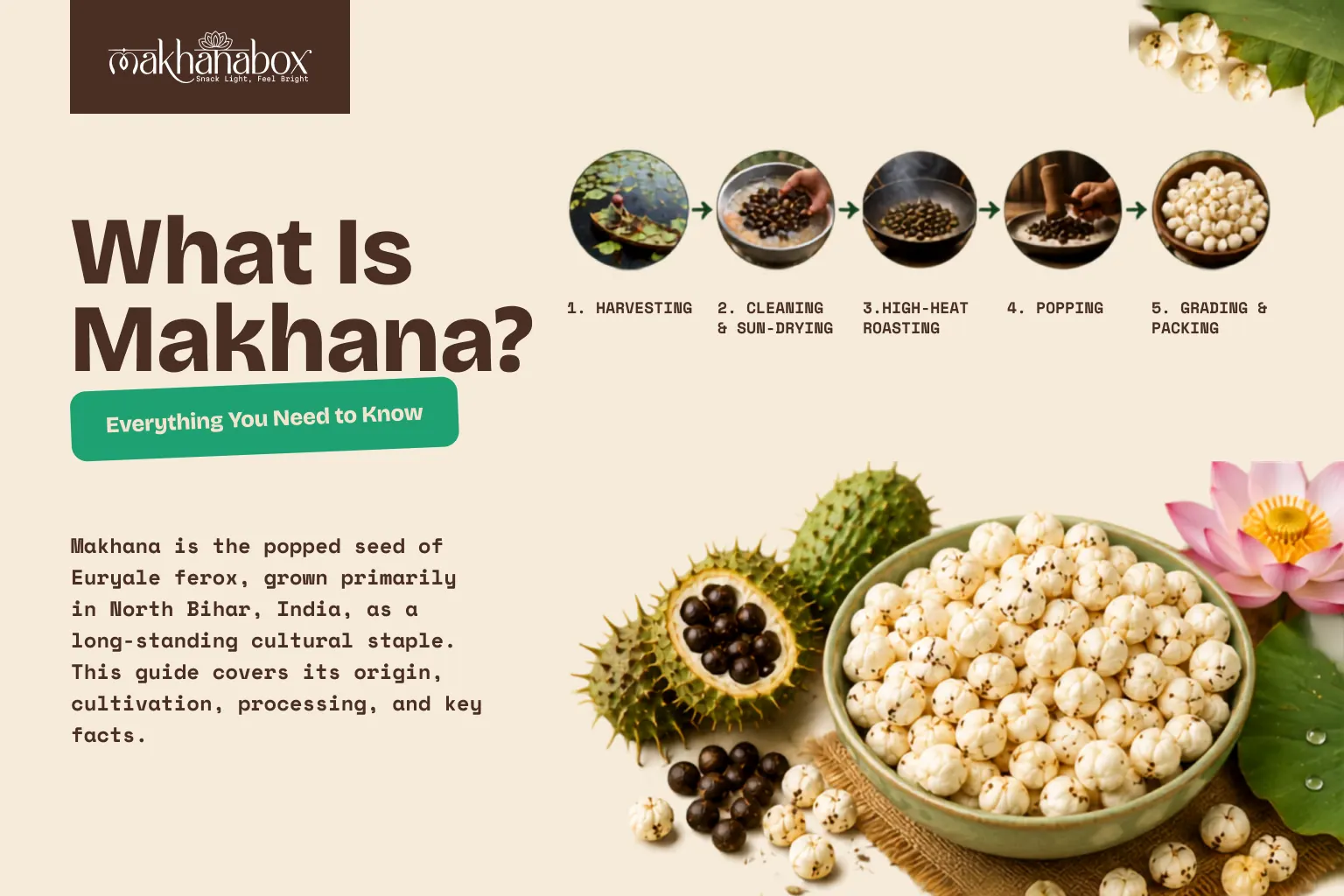
Makhana is the popped, dried seed of Euryale ferox, an aquatic plant grown in freshwater ponds — almost entirely in North Bihar, India, which produces the large majority of the world's supply. Sold roasted as a snack or raw for home cooking, it's been part of Bihari diets and Mithila's culture for generations, long before "superfood" entered the conversation. This is the full picture: the plant itself, how it's grown and processed, what the numbers actually say about it, and where to go for a deeper look at any one piece.
The plant, botanically
Euryale ferox is a monotypic genus — the only species in its genus — in the water lily family, Nymphaeaceae. It's native across South and East Asia, from northern India through China, Korea and Japan. The plant's leaves are enormous, often exceeding a metre across, with a distinctive purple vein pattern on the underside, and both the leaves and stems carry sharp prickles — which is where the genus name comes from: Euryale was one of the Gorgons in Greek mythology, a nod to the plant's fearsome spines, and ferox is Latin for "fierce." The flowers are small, mostly self-pollinating without ever fully opening, and give way to a spiny fruit pod that holds the seeds we know as makhana. Globally the species is classified as Least Concern, though it's considered vulnerable in Japan and South Korea, where wild populations have declined.
Where it grows, and why Bihar specifically
Makhana needs shallow, calm freshwater ponds and full sun — conditions North Bihar's floodplain wetlands (locally called chaurs) provide in abundance, particularly across the Mithila region's districts of Darbhanga, Madhubani and Purnia. That geography is the entire reason India, and specifically Bihar, dominates world production — reporting consistently puts India's share at around 85–90% of the global supply, with Bihar accounting for the large majority of India's own output. We go into the full growing cycle — planting, months underwater, flowering and harvest — in our piece on the makhana growing calendar, and the production numbers specifically in why Bihar grows most of the world's makhana.
How it's harvested and popped
Nothing about this process is mechanised. Harvesting is traditionally done by wading — sometimes swimming — into ponds to pull ripe seed pods out by hand, work historically carried out by the Mallah community. Once harvested, the seeds are sun-dried, sorted by size, then heated and struck individually to make them pop into the light, puffed white shape sold as makhana — a process that turns a hard, dark seed into the crisp snack base almost entirely through skilled manual labour and heat, with no oil involved at any stage. We walk through the complete pond-to-pouch process, step by step, in how we process raw makhana and specifically the popping stage in how makhana is roasted.
Grades: what the "suta" number means
Raw makhana is sold by seed size, graded using a traditional unit called suta — the higher the number, the larger and generally more premium the seed. We sell four grades, from 3 Suta (smallest, suited to flour and bulk cooking) up to 6+ Suta (largest, suited to snacking and gifting). The full explanation of how grading actually works — sieve sizes, not guesswork — is in our suta grading guide.
The GI tag: what "Mithila Makhana" legally means
In April 2022, "Mithila Makhana" received Geographical Indication (GI) status — a legal designation that ties the name specifically to makhana genuinely grown in the Mithila region, the same category of protection behind names like "Darjeeling tea" or "Champagne." It's not a quality grade or a certification of taste; it's a guarantee of origin, meant to protect growers in the region from the name being used for makhana grown elsewhere. The full explanation of what the tag does and doesn't guarantee is in our GI tag explainer.
Nutrition, briefly
Raw makhana runs about 350 kcal, 9.7g protein, 0.5g fat, 77g carbohydrate and roughly 14.5g fibre per 100g. Dry-roasted and lightly salted, the numbers land close to that — around 347 kcal and 9.7g protein per 100g — since roasting adds heat and seasoning, not oil. It's naturally low-fat because nothing about the process involves frying. That's a summary, not the full story: we've published the complete macro comparison across all six flavours in our nutrition facts breakdown, and a full vitamin-and-mineral table in our vitamin & mineral breakdown.
How makhana is actually eaten
Two broad forms. Roasted and seasoned, it's a ready-to-eat snack — what we sell, across six flavours from a plain Classic Roasted to spiced and sweet options. Raw and unroasted, it's a cooking ingredient: simmered into kheer (a traditional milk-and-makhana pudding), added to curries, or roasted yourself at home in ghee or oil. It's also widely eaten during religious fasting (vrat) periods like Navratri, since it's considered a suitable "fasting food" in many Hindu traditions — we cover that specifically in makhana for Navratri & vrat fasting, and the deeper cultural and religious context in makhana as prasad in Mithila culture.
Storing it without losing the crunch
Makhana has no preservatives, which means it absorbs ambient moisture fairly quickly once a pouch is opened — the crunch that makes it worth eating starts to soften within days in humid conditions. The fix is simple: keep it in an airtight container, and if it does go soft, a quick two-minute dry-pan or oven reheat brings the crunch back. The details are in why makhana goes soft, and the two-minute fix.
Frequently asked questions
What is makhana made from? Makhana is the popped, dried seed of Euryale ferox, an aquatic plant in the water lily family that grows in freshwater ponds. It isn't made from anything else — the seed itself, hand-harvested and hand-popped, is the entire product before any roasting or seasoning is added.
Is makhana a nut or a seed? A seed. "Fox nut" is a common English name, but botanically makhana isn't a nut at all — it's the seed of an aquatic plant, harvested from spiny pods that grow in ponds rather than on a tree.
Where does makhana grow? Almost entirely in the freshwater ponds and wetlands of North Bihar, India — particularly the Mithila region (districts like Darbhanga, Madhubani and Purnia). India accounts for the large majority of the world's makhana supply, and Bihar accounts for the large majority of India's.
Why does makhana have a GI tag? "Mithila Makhana" received Geographical Indication status in April 2022, legally tying the name to makhana genuinely grown in that region — the same kind of protection behind names like "Darjeeling tea." It's a legal guarantee of origin, not a quality grade.
Is makhana healthy? Roasted makhana is naturally low in fat, cholesterol-free and a source of plant protein and fibre, largely because it's dry-roasted rather than fried. It's a genuinely reasonable snack choice, though — like any food — it isn't a cure-all, and portion size still matters.
How is makhana eaten? Two ways: roasted and seasoned as a ready-to-eat snack (what we make), or raw and unroasted for cooking into kheer, curries, or roasting yourself at home. It's also a common fasting (vrat) food during festivals like Navratri.
About Makhana Box
We're a Patna-based, Bihar-sourced makhana brand — everything above is the context behind what we actually sell. Browse our six roasted flavours, the raw grades for your own kitchen, or read our story for more on why we do it this way. Reach us anytime:
- Phone: +91 91559 97784
- Email: sales@makhanabox.com
This article is for general information and is not medical or nutritional advice. If you have a health condition, please consult a qualified professional.