
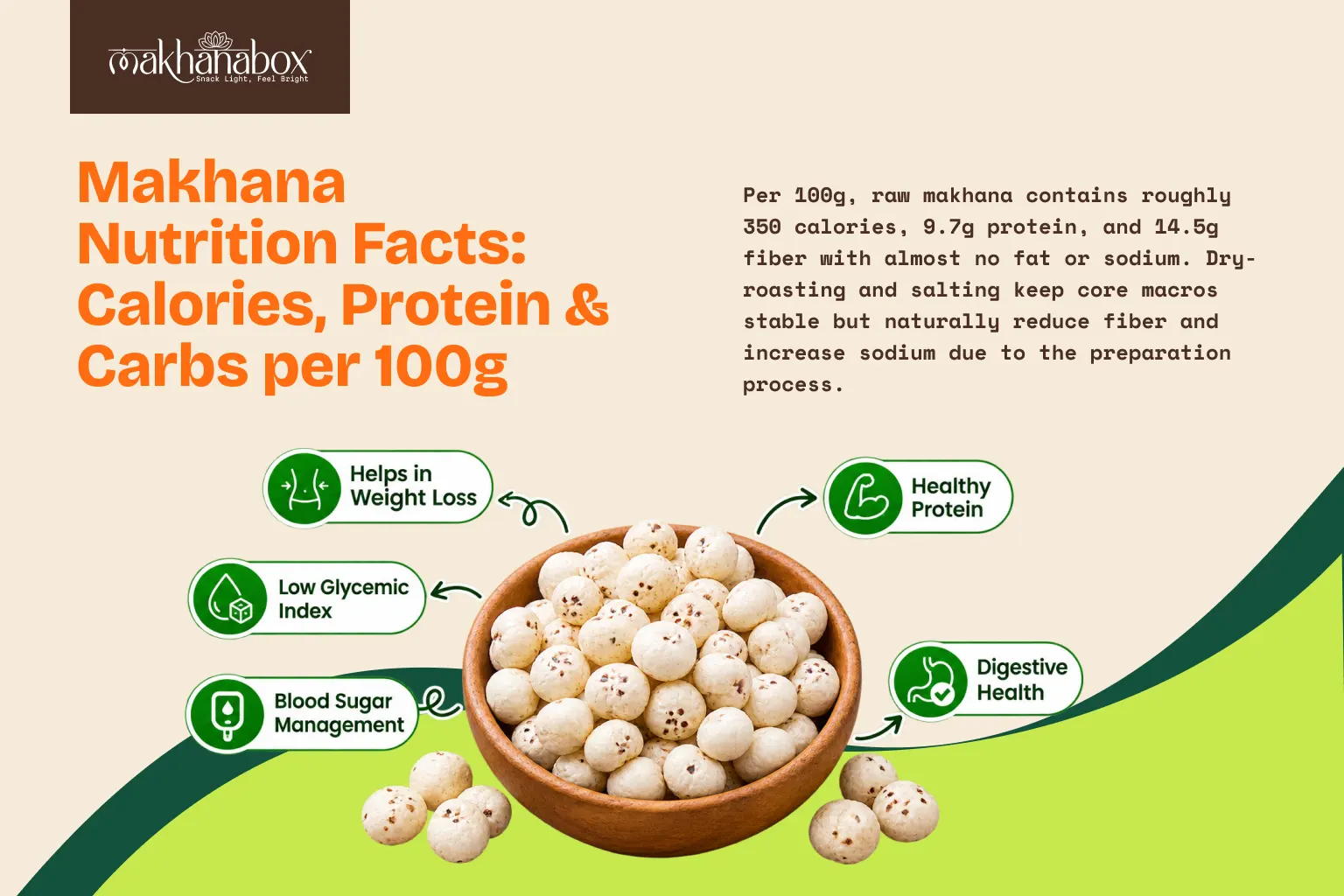
Per 100g, raw makhana has about 350 kcal, 9.7g protein, 0.5g fat, 77g carbohydrates, 14.5g fibre and roughly 1mg sodium. Dry-roasted and lightly salted (our Classic Roasted flavour), it's close: 347 kcal, 9.7g protein, 0.6g fat, 76.9g carbs, 3.5g fibre and 210mg sodium — the sodium and lower fibre figure come from the roasting-and-salting process, not from the seed changing. Below is where those numbers come from, what they actually mean at snack-sized portions, and how the different Makhana Box flavours vary.
The raw number, straight from the seed
Raw, unroasted phool makhana — the same grade we sell as 3 Suta through 6+ Suta — carries roughly 350 kcal, 9.7g protein, 0.5g fat, 77g carbohydrates, 14.5g dietary fibre and about 1mg sodium per 100g, per our own raw makhana product data. That's the seed in its natural state: no oil, no salt, no seasoning. The 14.5g of fibre is the standout figure here — that's a genuinely high number for a snack-adjacent food, well above what you'd see in most grains.
What roasting and seasoning change
Once makhana is dry-roasted and seasoned, three things shift. Sodium climbs, because salt is added — our Classic Roasted comes to 210mg per 100g, still modest next to a bag of chips. Fat rises a little with an oil-based coating (Peri-Peri and Cheese & Herb sit around 3.8–4.6g per 100g), though it stays far below fried snacks. And the fibre figure on the nutrition panel drops from raw makhana's 14.5g to roughly 3–3.5g on the roasted pouches — we can't say with certainty how much of that gap is roasting itself versus how the two figures were tested and reported, but either way, don't expect the roasted pouch label and the raw seed label to read identically. See our full nutrition breakdown for the complete roasted-makhana table.
How the six flavours compare
Not every pouch is nutritionally identical, because the seasoning is real seasoning, not a dusting. Per 100g: Classic Roasted comes in at 347 kcal / 9.7g protein / 0.6g fat / 210mg sodium. Himalayan Pink Salt is close behind at 345 kcal / 9.8g protein / 0.5g fat / 195mg sodium — our lowest-sodium option. Tangy Masala runs 355 kcal / 9.4g protein / 1.1g fat / 365mg sodium. Peri-Peri and Cheese & Herb carry more fat from their oil-based coatings, at 362 kcal/3.8g fat and 368 kcal/4.6g fat respectively, with sodium in the 340–380mg range. Dark Chocolate is the outlier, at 398 kcal and 8.2g fat per 100g, since it's coated in actual chocolate rather than a dry spice blend. Full tables live on each flavour's page.
What these numbers mean at snack-sized portions
Nutrition panels are always per 100g, but almost nobody eats 100g of anything in one sitting. A more realistic handful is somewhere around 20–30g, which puts a typical serving of roasted makhana at roughly 70–105 kcal and 2–3g of protein — modest, but earned without much fat. The practical comparison people usually want is protein per handful versus other snacks: makhana's protein-to-fat ratio is unusually good, because there's no deep frying involved, even though nuts like almonds beat it on raw protein-per-100g (at the cost of roughly double the calories).
Where makhana sits against other snacks
At 9.7g protein per 100g, roasted makhana beats potato chips (around 6.5g protein per 100g) on protein while carrying a fraction of the fat, since chips are fried and makhana isn't. Fried namkeen mixes can post higher protein numbers, but usually with meaningfully more fat riding along. Roasted almonds and cashews out-protein makhana outright, but at roughly double the calories per 100g — useful if you're optimising for protein density, less useful if you're watching total intake. None of this makes makhana a "superfood" that erases the rest of your diet; it's a snack with a genuinely favourable nutrition profile compared to the fried alternatives most people reach for.
Frequently asked questions
How many calories are in 100g of makhana? Raw makhana runs around 350 kcal per 100g. Roasted, plain-salted makhana (our Classic Roasted) comes in close to that at 347 kcal per 100g — roasting and light seasoning don't add much, since there's no frying involved.
How much protein is in makhana? Roughly 9.7g of protein per 100g for both raw and roasted plain makhana. That's a genuinely useful amount for a plant-based snack, though it's less than nuts like almonds gram for gram.
Is makhana high in carbs? Yes, relatively — around 77g per 100g, which is closer to a grain than a nut. What matters in practice is that a realistic serving is much smaller than 100g, and the carbs come with fibre attached rather than being all starch.
Does roasting change makhana's nutrition much? Not dramatically, when it's dry-roasted rather than fried. The biggest shifts come from added seasoning — salt and spice blends raise sodium and fat a little, and a sweet coating like dark chocolate raises fat and sugar more noticeably.
Is makhana good for weight management? It can fit well because it's low in fat and reasonably filling for its calorie count, but no single food manages weight on its own — portion size and your overall diet matter more than any one snack.
About Makhana Box
Every number in this article is pulled straight from the nutrition tables we publish on our own product pages — nothing here is invented for the sake of a tidier article. If you want to compare a specific flavour or raw grade side by side, our nutrition & benefits page and raw makhana listings have the full breakdowns — and for the full vitamin and mineral picture beyond calories, protein and carbs, see our complete vitamin & mineral breakdown. Reach us anytime:
- Phone: +91 91559 97784
- Email: sales@makhanabox.com
This article is for general information and is not medical or nutritional advice. If you have a health condition, please consult a qualified professional.