
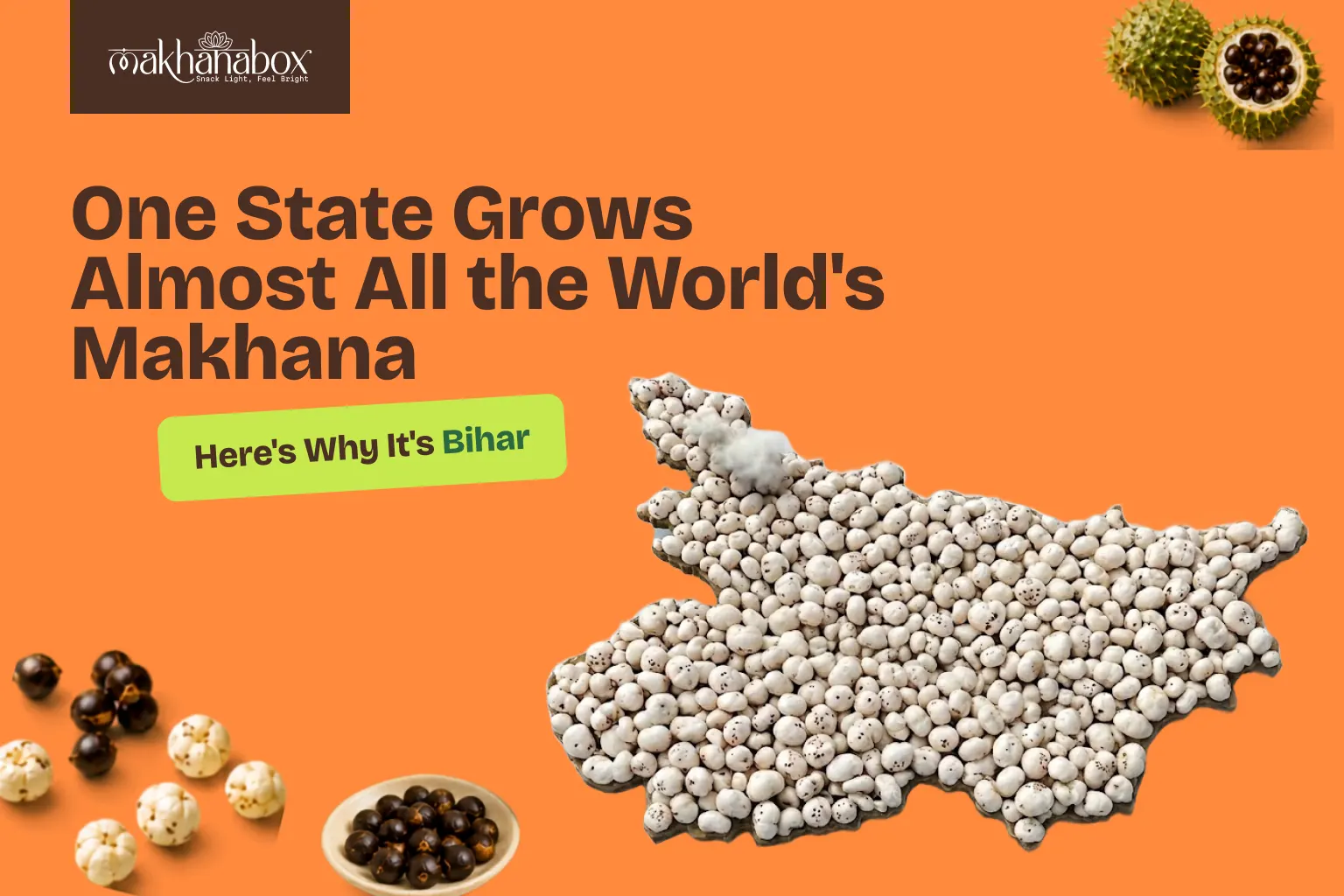
Almost every packet of makhana you've ever eaten, anywhere in the world, most likely traces back to one Indian state: Bihar. Estimates vary by source, but Bihar's share of global makhana production is widely reported to be somewhere around 80-90% — an unusually concentrated supply chain for a food that's now sold worldwide. The reason isn't tradition alone. It's geography.
The plant that needs a very specific kind of water
Makhana comes from the seed of Euryale ferox, the prickly water lily, an aquatic plant that only thrives in shallow, still or slow-moving freshwater — ponds, oxbow lakes, and seasonal wetlands with a muddy, nutrient-rich bed. It's not a crop you can simply plant in a dry field with irrigation. It needs standing water for most of its growing cycle, consistent warmth, and the kind of silty, organically rich pond bottom that takes years, sometimes generations, of natural wetland activity to build up.
That's a narrow set of requirements, and it happens to describe a huge stretch of north Bihar almost perfectly.
Bihar's wetlands: chaurs, mauns, and a lot of water
North Bihar, and the Mithila region in particular, sits on the floodplain of the Ganga, Kosi, Gandak, and several smaller rivers. The land is dotted with what locals call chaurs and mauns — natural depressions and seasonal wetlands that fill with water during the monsoon and hold it, sometimes year-round, in low-lying pockets. Combined with a genuine density of man-made ponds built up over generations specifically for aquaculture and makhana cultivation, the region has an unusually large amount of exactly the kind of shallow freshwater habitat this plant needs.
Rainfall patterns, river flooding, and the flat, low-lying terrain all work together here in a way that's difficult to find at the same scale anywhere else. Growing makhana isn't something Bihar's farmers imposed on the land — it's closer to a crop the land was already suited to, that generations of growers learned to work with.
Why "flood-prone" isn't the whole story
North Bihar is often described, accurately, as flood-prone — a real and serious challenge for the region in general. It's tempting to treat that purely as a liability. But for a wetland-native crop like makhana, seasonal flooding is also what recharges the ponds and chaurs the plant depends on. Land that's genuinely difficult for most conventional agriculture because it floods can be exactly the land where an aquatic crop like this makes sense instead.
That doesn't make flooding simple good news — growers still describe it as something they manage carefully rather than benefit from automatically. Excess or badly-timed flooding can damage a season's crop just as easily as too little water can. The honest version is that Bihar's wetland geography is both the reason this crop can exist here at a scale unmatched elsewhere, and a genuine ongoing risk the people who grow it live with every season.
Generations of specific know-how
Geography explains why makhana can grow in Bihar. It doesn't fully explain why the region dominates global supply the way it does — that also comes down to know-how that isn't easily copied. Harvesting makhana seed pods from a thorny aquatic plant, drying the seed correctly, then hand-roasting and hand-popping it into the light puff sold as a snack, is a skilled, labour-intensive process refined over generations in this specific region. That combination — the right wetlands and a large base of growers and processors who know exactly how to work them — is much harder to replicate quickly elsewhere than the plant's basic growing requirements alone.
Frequently asked questions
What percentage of the world's makhana comes from Bihar? Exact figures vary by source and year, but Bihar's share is widely reported to be somewhere around 80-90% of global makhana production, concentrated heavily in the state's Mithila and Seemanchal regions.
Why does makhana grow so well in Bihar specifically? Bihar has a large network of shallow, still-water ponds and seasonal wetlands (locally called chaurs and mauns) fed by its rivers and monsoon flooding — exactly the growing conditions Euryale ferox, the plant makhana comes from, needs.
Can makhana be grown outside Bihar? Yes, in principle, anywhere with similar shallow freshwater wetland conditions — and some cultivation happens in neighbouring states and countries. But Bihar's combination of scale, generations of grower expertise, and existing wetland ecosystems is difficult to replicate quickly elsewhere.
Are Bihar's floods actually good for makhana? Seasonal flooding is a double-edged reality: it's exactly what recharges the wetlands Euryale ferox needs to grow, but unpredictable or excessive flooding can also damage a season's crop and complicate harvest timing. Growers describe it as a resource they depend on and manage carefully, not a simple asset.
About Makhana Box
We're based in Patna and source directly from growers within this same Bihar wetland belt — you can read the full sourcing story on our About page. If you'd like to see the raw seed itself, graded by size the way local traders have long done it, our raw makhana page has all five grades. Reach us anytime:
- Phone: +91 91559 97784
- Email: sales@makhanabox.com
This article is for general geographic and historical context and isn't a precise market-share or agricultural statistic — figures on regional production share vary by source and year.