
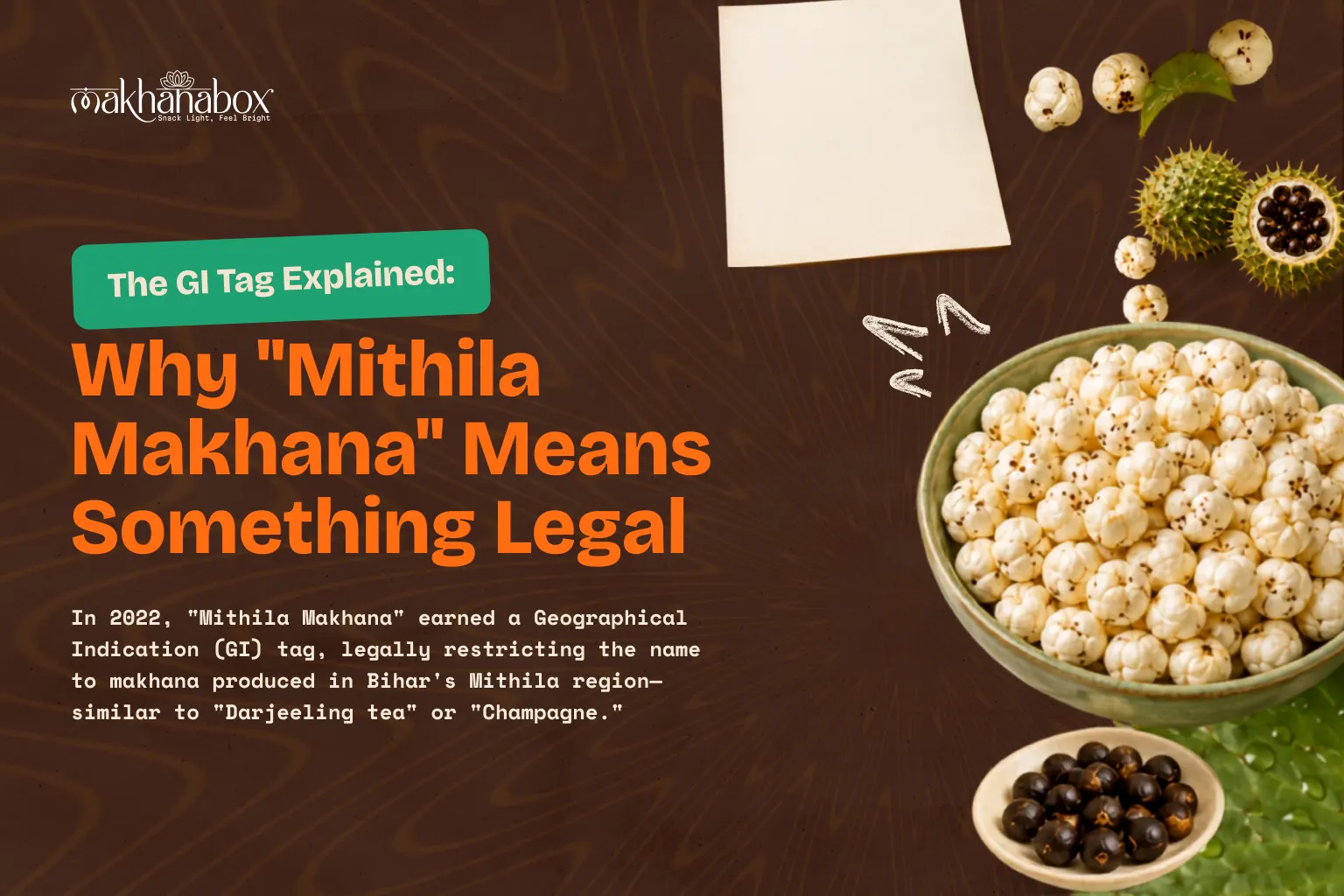
In 2022, "Mithila Makhana" became a legally protected name in India — a Geographical Indication (GI) tag granted by the Government of India that ties the name specifically to makhana grown and processed in the Mithila region of Bihar. It works the same way "Darjeeling tea" or "Champagne" work: a name that isn't just descriptive, but legally restricted to a place.
What a GI tag actually is
A Geographical Indication is a form of intellectual property protection, administered in India by the Geographical Indications Registry under the Ministry of Commerce and Industry. It's granted to a product whose qualities, reputation, or characteristics are essentially tied to its place of origin — not because someone invented a clever name, but because the place itself (its soil, water, climate, or a long-standing local method) genuinely shapes the product.
The classic international examples are useful shorthand: sparkling wine can only be called "Champagne" if it's made in the Champagne region of France using the traditional method; tea can only carry the "Darjeeling" name if it's grown in specific gardens in that Himalayan district. India has used the same tool to protect names like Basmati rice, Kanchipuram silk, and Nagpur oranges. A GI tag doesn't stop anyone from growing a similar product elsewhere — it stops them from using the protected name for it.
Mithila Makhana's GI tag, plainly stated
Mithila Makhana received GI certification in 2022. This is a matter of public record, not a marketing claim — it formally recognises makhana grown in the defined districts of the Mithila region of Bihar (and the traditional cultivation and processing practices used there) as a distinct, geographically-rooted product. It sits alongside a small number of other Bihar-origin products that have gone through the same registration process in recent years, part of a broader push to get formal recognition for regional agricultural products across India.
What the certification does not do is rank or grade individual batches. It doesn't mean every bag labelled "Mithila Makhana" is identical in size, freshness, or roast quality — those still vary by grower, processor, and how the seller handles the seed after harvest. What it protects is narrower and, in its own way, more important: the right to use that name at all.
Why this matters if you're buying, not just growing
For a buyer, a GI tag is closest in spirit to a certification of authenticity. It gives you a legal basis to expect that a product genuinely labelled "Mithila Makhana" traces back to that specific belt of Bihar and its traditional growing practices — rather than makhana grown elsewhere and relabelled to borrow the region's reputation. Given how much of makhana's value (and price) rests on where and how it was grown, that distinction is not a small thing.
It's also a reasonable proxy — though not a guarantee — for supporting the region's actual growers rather than a supply chain that has quietly moved elsewhere while keeping the name.
Why this matters for farmers
For the growers themselves, a GI tag is primarily a legal and economic protection. It gives producer groups within the region standing to object if someone outside the defined area starts selling ordinary makhana under the "Mithila" name — a real risk once a regional name starts carrying market value. Over time, GI status is also meant to support better branding, easier market access, and in some cases pricing power for the legitimate regional product, since buyers (increasingly including exporters) have a name they can look for and trust.
None of that happens automatically just because a tag exists — enforcement, awareness, and market building all still take real work. But the legal foundation itself is a meaningful step, and one that didn't exist before 2022.
Where Makhana Box fits into this
We're a small operation, not a GI-certification body, and we don't currently put a formal GI mark on our packaging. What we can tell you plainly is where we actually source from: growers and processors within Bihar's Mithila and Seemanchal belt — the same region this GI tag was created to protect — rather than an anonymous national supply chain. You can read more about how we source and roast on our About page, and see the raw, ungraded seed itself on our raw makhana page, sorted by size grade the way the region's traders have long done it.
Frequently asked questions
What does GI tag mean for Mithila Makhana? It means "Mithila Makhana" is a legally protected name under India's Geographical Indications system — only makhana genuinely grown and processed in the defined Mithila belt of Bihar can be sold under that name, similar to how only sparkling wine from Champagne, France can be called Champagne.
When did Mithila Makhana get its GI tag? The Geographical Indications Registry granted GI certification to Mithila Makhana in 2022, recognising it as a product tied to the specific geography, growing conditions and traditional practices of the Mithila region of Bihar.
Does a GI tag mean higher quality? Not directly — a GI tag certifies origin and traditional method, not a quality grade. In practice, though, it protects the reputation that made the name valuable in the first place, which indirectly supports quality standards within the region.
Does Makhana Box sell GI-tagged makhana? We source raw and roasting-grade makhana from growers and processors within Bihar's Mithila and Seemanchal belt — the same region the GI tag covers — though as a small business we haven't pursued formal GI-certification labelling ourselves yet.
Is a GI tag the same as a trademark? No. A trademark protects one company's brand name; a GI tag protects a name tied to a place and can be used by any eligible producer within that region who meets the defined standard — no single company owns it.
About Makhana Box
We dry-roast makhana sourced from Bihar's Mithila and Seemanchal belt — the same region behind the GI tag discussed above — in small batches out of Patna. Read the full story on our About page, or browse the ungraded, unroasted seed by size on our raw makhana page. Reach us anytime:
- Phone: +91 91559 97784
- Email: sales@makhanabox.com
This article is for general historical and informational context about India's Geographical Indications system and is not official legal or trade guidance. For legal specifics, consult the Geographical Indications Registry or a qualified professional.