
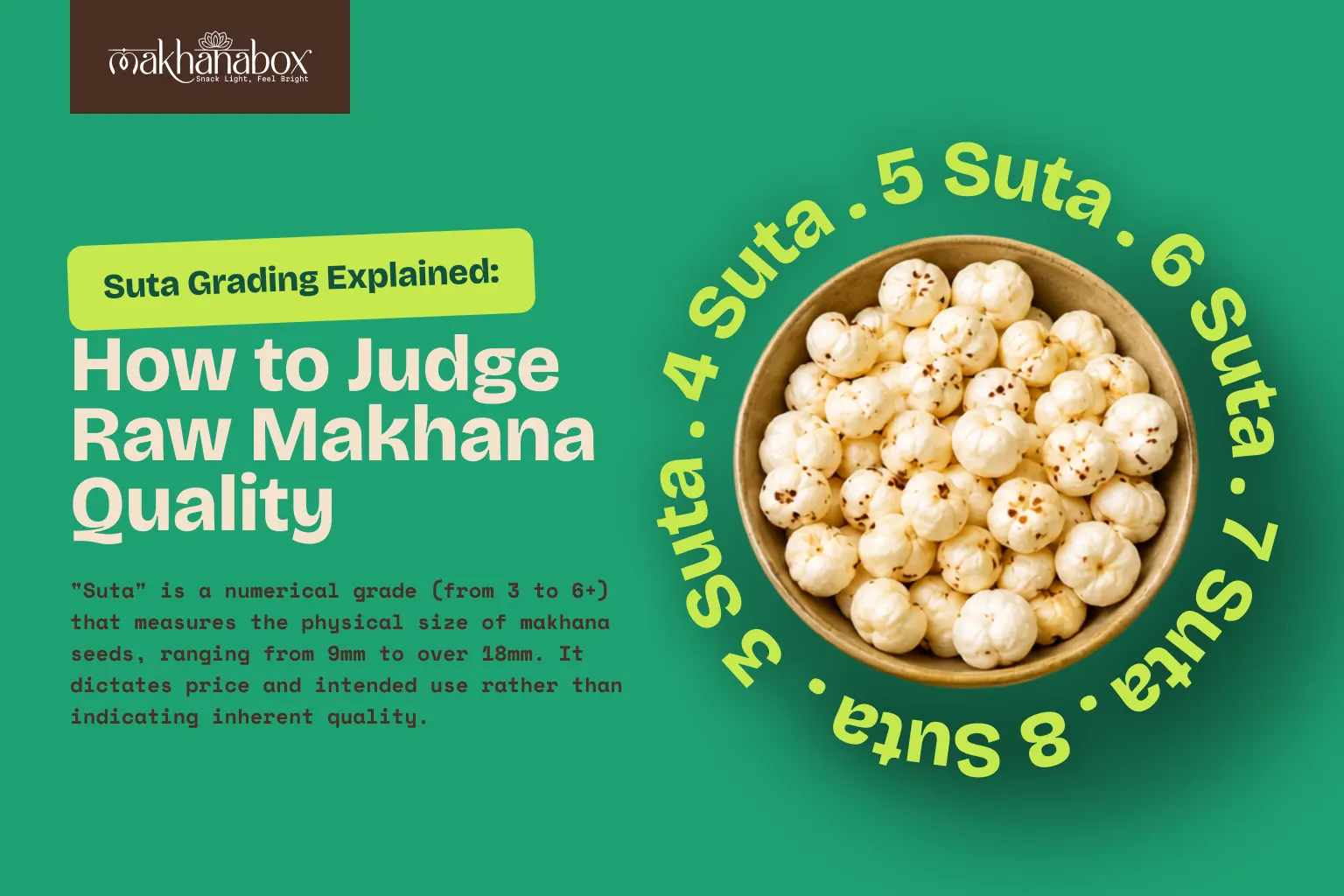
Suta is the size grade printed on every bag of raw makhana we sell — a number from 3 to 6+ that tells you how big the individual seeds are, from small (3 Suta, roughly 9–12mm) up to our largest, premium grade (6+ Suta, 18mm and up). It isn't a quality score in the sense of "better" or "worse" seed; it's a size measurement, and size is what decides both the price and what a grade is actually good for.
What "suta" actually measures
"Suta" is the term growers and traders across Bihar's makhana belt use for seed-size grading — the word itself means "thread" in Hindi, and the sizing tradition is generally described as growing out of simple hand tools like sieves and gauges, long before anyone was measuring seeds with calipers in a village processing shed. We can't point you to a precise, well-documented history of exactly how the numbering started, and we'd rather say that plainly than invent a tidy story. What we can tell you with certainty is what the numbers mean today, because it's the same system we buy against: bigger suta number, bigger seed.
At Makhana Box, that scale runs across four grades — 3 Suta, 4 Suta, 5 Suta, and 6+ Suta — each sold raw and unroasted, so you can cook or roast it your own way.
How the grading happens, in practice
Grading is a sieving job, not a guessing job. Once popped seeds are dried, they're passed through sieve screens with different hole sizes — seeds too big to fall through one screen but small enough to pass the next land in the same size band. It's the second of the four steps we walk through in full on how we process raw makhana: harvest, then dry and grade, then pop, then weigh and pack. Grading happens before packing, which is exactly why what you order is what arrives — a 5 Suta pack isn't "mostly 5 Suta with some strays," it's been sieved to that band specifically.
Why a bigger number costs more
Three things push the price up as the grade climbs, and none of them is about one seed being "more authentic" than another:
Yield. Any given harvest produces far more small-to-medium seed than large seed — big, evenly-formed seeds are simply rarer per batch. So a kilo of 6+ Suta takes more raw harvest to assemble than a kilo of 3 Suta.
Visual appeal for gifting. Larger, uniform pops look noticeably better in a gift box or festival spread — this is the grade people reach for when presentation matters, not just taste.
Popping consistency. More uniform seed size tends to pop more evenly under heat, which matters if you're roasting a batch at home and want consistent texture through the whole pan rather than a mix of over- and under-popped pieces.
Which grade should you actually buy?
This is the part most sites skip, so here's the practical version, straight from what each grade is actually used for:
3 Suta (9–12mm, Extra Small) — the smallest grade and the best value per gram. Once it's ground into flour or blended into a besan-style mix, seed size barely matters, which is exactly why bulk kitchens and home cooks making their own makhana atta reach for this first.
4 Suta (12–15mm, Small) — small and budget-friendly, a step up from 3 Suta. Good for flour, and fine for home roasting where you're not chasing a big, showy pop.
5 Suta (15–18mm, Medium) — our most-ordered grade, and the one we'd suggest if you're not sure where to start. Big enough for a satisfying roast-at-home snack, everyday enough for a weekly pot of kheer.
6+ Suta (18mm and up, Large) — our largest and most premium grade, export-quality seed for the biggest, crunchiest pops and the best presentation once roasted. The grade to pick for gifting or festival cooking.
Not sure? Mix grades instead
You don't have to commit to one grade for every use in your kitchen. Our custom raw makhana mix lets you combine grades in a single order — say, 3 Suta for flour and 6+ Suta for snacking — without placing two separate orders and paying two separate shipping charges. It's worth a look before you default to buying the same grade for everything.
Frequently asked questions
What does "suta" mean in makhana grading? Suta is the traditional size grade used to sort raw makhana by seed diameter. The number — 3 through 6+ at Makhana Box — increases with seed size, so 3 Suta is our smallest grade and 6+ Suta is our largest and most premium.
Why is a higher suta grade more expensive? Larger seeds are naturally rarer in any harvest, so our largest grade, 6+ Suta, yields less usable seed per batch than a smaller grade like 3 or 4 Suta. Larger, more uniform seeds also tend to pop more consistently and present better for gifting, which adds to the premium.
Which suta grade is best for kheer or everyday snacking? 5 Suta (15–18mm) is our most-ordered grade for exactly this — big enough to feel satisfying roasted at home, everyday enough for a regular pot of kheer.
Can I buy a mix of different suta grades in one order? Yes — our custom raw makhana mix lets you combine grades in one order, for example a bulk grade for flour alongside a premium grade for snacking, instead of placing two separate orders.
About Makhana Box
We sell raw, unroasted makhana across all four suta grades, sieved and packed to order rather than pulled off a shelf — see the full range on raw makhana, or build your own blend on custom raw makhana mix. If you're still unsure which grade fits your recipe or your order size, just ask us. Reach us anytime:
- Phone: +91 91559 97784
- Email: sales@makhanabox.com
This article describes general practice in makhana grading and processing and may vary by grower, season, and batch.