
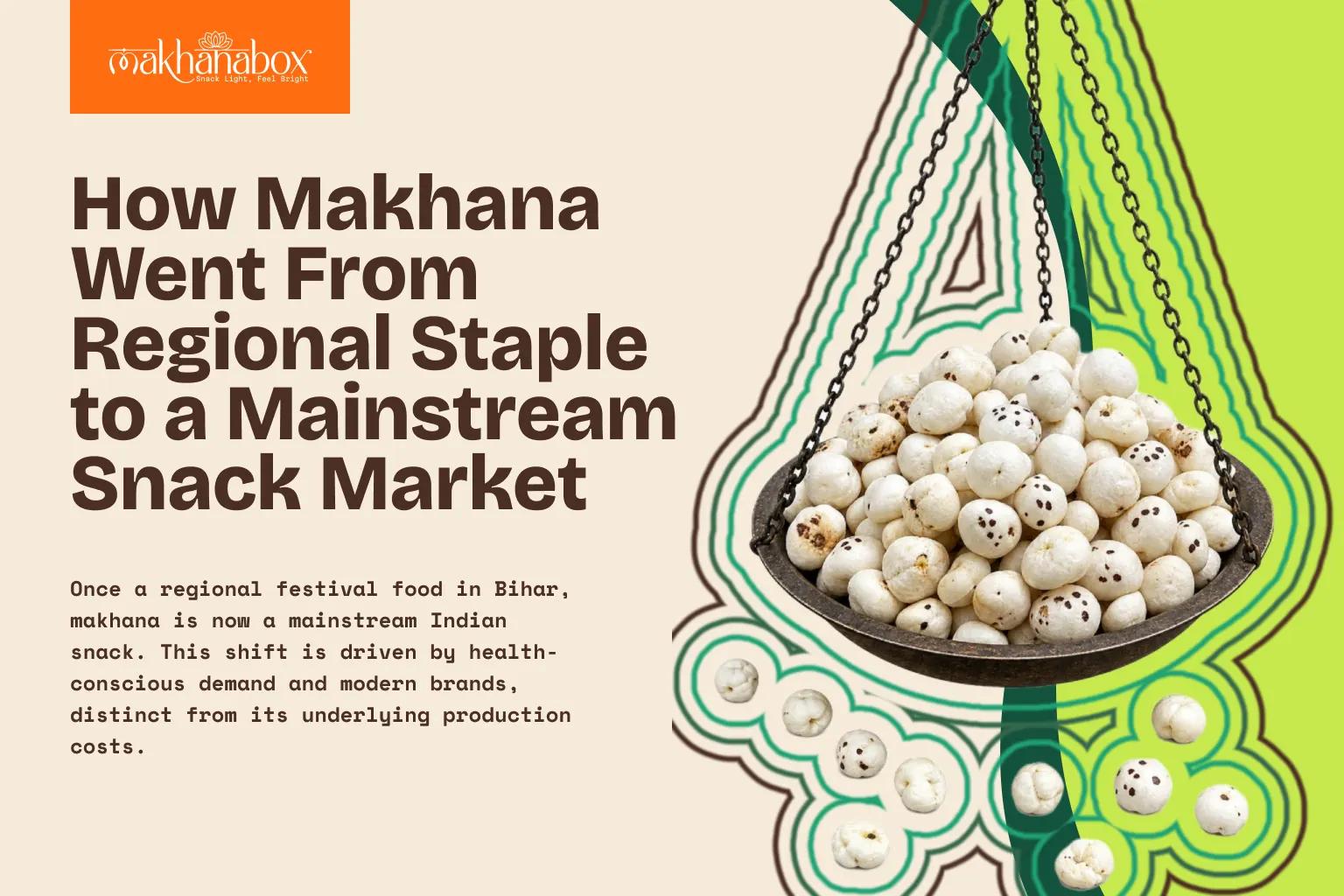
Long before anyone put "superfood" on a makhana packet, the seed already had a place in Mithila life that had nothing to do with protein counts or Instagram snack trends. In the region of north Bihar where most of the world's makhana is grown, it has been part of religious offerings, festival food, and wedding tables for generations — a food embedded in culture first, marketed as wellness second.
A food that was already meaningful before it was "healthy"
It's easy, writing about a snack that's now sold on nutrition claims, to lose sight of the fact that for the people who've grown and eaten it for generations, makhana was never primarily about macros. It was — and still is — a food tied to place, season, and occasion. Understanding that context doesn't compete with the nutrition story; it explains why the nutrition story landed on fertile ground. A food doesn't casually become part of a region's religious and ceremonial life. That kind of role tends to reflect something the community already valued about it — as a reliable, locally-grown, easily-prepared food available at the right times of year.
Prasad and religious offerings
In Mithila, makhana has a long-standing presence in religious offerings and puja preparations. As with most regional food-and-ritual traditions in India, the specifics vary quite a bit by family, community, and the particular occasion — there isn't one single fixed rule that applies everywhere. What's consistent is the broader pattern: this is a food that shows up in preparations meant for devotional purposes, not only as an everyday snack. We'd rather describe that honestly and generally than claim a specific, uniform ritual that doesn't actually hold across every household and community in the region.
Weddings and festival tables
Makhana also has a recognised place in wedding feasts and festival cooking across Bihar, particularly in Mithila. It turns up in sweet preparations like kheer, in roasted and dry-fried forms, and in various local dishes served at celebrations — again, with real variation from one family's kitchen to another rather than a single standardised menu. The throughline is simpler than any specific recipe: this is a food people reach for when an occasion matters, which is its own kind of endorsement, older and quieter than any marketing claim.
Why this context is worth knowing
None of this is a religious claim we're making about our own products — we're a snack company, not an authority on ritual practice, and customs genuinely differ across families and communities within the region. What we do think is worth knowing, as a customer eating this food, is that it isn't a recent invention dressed up as tradition. The deep local roots came first. The "superfood" framing arrived decades, sometimes generations, later, layered on top of a food that Mithila already valued for reasons that had nothing to do with a nutrition label.
That's part of why we find the sourcing story worth telling at all — makhana isn't just an ingredient we picked because it's trendy. It's a food with a long life in the region we source it from, and we'd rather our customers understand that background than think it started with a snack aisle.
Frequently asked questions
Is makhana used as prasad in religious offerings? Yes — in the Mithila region of Bihar, makhana has long been used in religious offerings and puja preparations, often alongside other local foods, well before it became known internationally as a health snack.
Is makhana associated with weddings in Bihar? Makhana appears in wedding feasts and ceremonial food traditions in Mithila and across Bihar more broadly, though exact customs vary by family, community, and specific occasion rather than following one fixed ritual.
Why is makhana considered culturally significant in Mithila, not just nutritious? It's a food that's been grown, eaten, and offered in this region for generations, tied into local ponds, festivals and family kitchens long before "superfood" marketing existed — the nutrition is real, but it's layered on top of a much older place in daily and ritual life.
Does Makhana Box make any specific religious or ritual claims about its products? No — we sell makhana as a snack and cooking ingredient. We describe the food's general cultural background as context, not as a religious product or claim about specific rituals, which vary by family and community.
About Makhana Box
We source and dry-roast makhana from Bihar's Mithila region — the same place carrying the traditions described above — and you can read more about that sourcing on our About page. If you want to taste the roasted, ready-to-eat side of this story, our flavours page has the full range. Reach us anytime:
- Phone: +91 91559 97784
- Email: sales@makhanabox.com
This article shares general cultural and historical context and isn't a description of any specific family's or community's religious practice, which varies widely.