
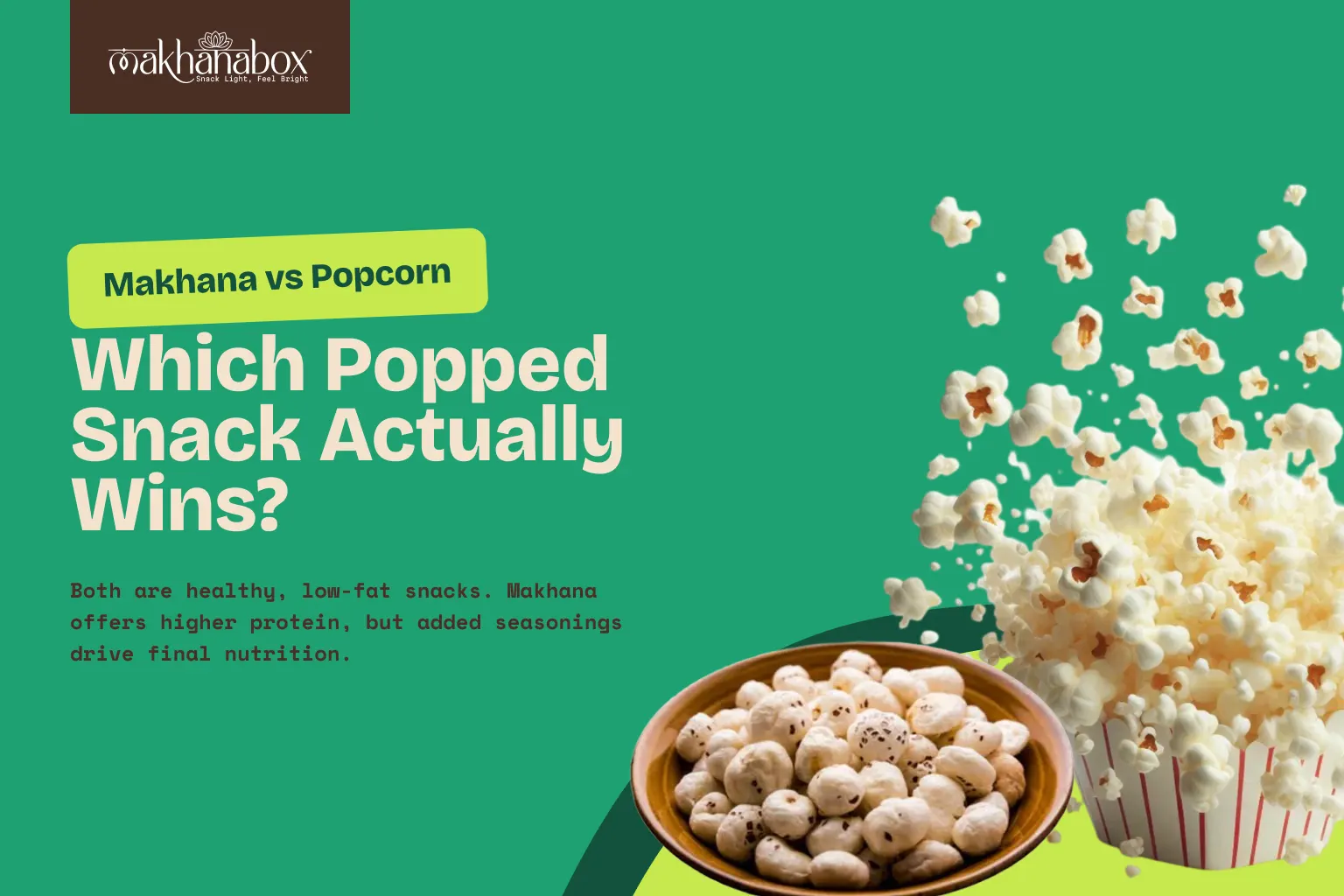
Neither snack "wins" outright — makhana and plain air-popped popcorn are both reasonably healthy, low-fat, popped whole foods from completely different plants, and the real gap between them usually comes down to protein content and, more than anything, what gets added on top. Here's the honest comparison, including the parts where popcorn holds its own.
Two different plants, two different pops
Despite both being sold as "popped" snacks, makhana and popcorn have almost nothing in common botanically. Makhana comes from the seed of Euryale ferox, the prickly water lily, hand-harvested from Bihar's ponds and popped by heat after drying. Popcorn comes from a specific variety of maize (Zea mays everta) whose kernels have a hard outer shell and a small amount of moisture inside that turns to steam under heat, causing the kernel to burst. The "pop" in each case is a genuinely different physical process — one is heat cracking a dried seed, the other is trapped steam exploding a kernel — and it produces two nutritionally distinct foods that just happen to share a marketing category.
Protein and fibre, side by side
Our Classic Roasted makhana carries about 9.7g of protein and 3-3.5g of fibre per 100g, with only about 0.6g of fat (full figures on our nutrition page). Air-popped popcorn is commonly reported at somewhere around 12-13g of protein and 14-15g of fibre per 100g of dry kernel — genuinely strong numbers on paper. But that 100g figure is for dense, unpopped kernels; once popped, the same weight of corn expands into a huge volume, so a typical bowl of popcorn as actually eaten weighs a lot less than 100g. Makhana's density is closer to what you actually eat in a handful. Compared as realistic servings rather than as lab-table 100g figures, the two end up closer than the raw numbers suggest, and makhana's protein tends to land more consistently per handful.
Where plain popcorn deserves credit
It would be easy for a makhana brand to write this section dismissively, and that would be dishonest. Plain, air-popped popcorn — no oil, no butter — is a genuinely reasonable snack: it's a whole grain, it's naturally low in fat, it has real fibre, and it's low-calorie for its volume. If someone air-pops their own corn at home and eats it unsalted or lightly salted, there's very little wrong with that as a regular snacking habit. This isn't a case where one popped snack is a health food and the other is junk food in disguise — both, in their plain forms, are solid choices.
Where the gap actually opens up: toppings
The real nutritional split between these two snacks rarely happens at the plant level — it happens at the topping level. Cinema-style and microwave popcorn are typically popped in oil to begin with, then coated in butter or a butter-flavoured topping with a heavy hand on salt, which can push fat and sodium up dramatically compared to the air-popped version. A large cinema tub with butter topping can carry a fat and sodium load that's simply not comparable to a plain bowl. Makhana's seasoning, by contrast, is a light finishing coat applied after dry-roasting rather than a cooking medium — even our more indulgent flavours like Peri-Peri or Cheese & Herb stay in a modest few grams of fat per 100g, nowhere near buttered popcorn's range. So the fair comparison isn't "makhana vs popcorn" in the abstract — it's "makhana vs however you're actually going to eat your popcorn," and that second part is where most of the real-world difference lives.
Sodium and where labels matter more than plants
Sodium follows a similar pattern to fat: it's driven far more by seasoning choices than by which plant the snack started as. Our Classic Roasted makhana sits at 210mg of sodium per 100g and Himalayan Pink Salt at 195mg, while a heavily salted popcorn — theatre-style or a salty packaged brand — can run well past that. But a lightly salted, home-popped bowl of popcorn can just as easily undercut a heavily seasoned makhana flavour like Tangy Masala. The plant isn't the variable that decides this; the recipe on top of it is, on both sides.
So which one should you actually reach for?
If you're comparing plain air-popped popcorn to plain roasted makhana, you're choosing between two decent, low-fat, reasonably filling snacks, and either is a fine everyday choice — the difference there is closer to personal taste than nutrition. If you're comparing makhana to butter- or cinema-style popcorn, makhana wins clearly on fat and usually on sodium, simply because of how much gets added to popcorn in that form. The most useful question isn't "makhana or popcorn" in the abstract — it's what's actually going on top of whichever one you're about to eat.
Frequently asked questions
Is makhana healthier than popcorn? It depends on the popcorn. Against plain, air-popped popcorn, the comparison is close — both are reasonably healthy, low-fat, whole-food snacks. Against butter- or cinema-style popcorn, makhana comes out ahead by a wide margin, mostly because of what's added on top rather than the corn itself.
Does makhana have more protein than popcorn? Yes, generally. Roasted makhana carries about 9.7g of protein per 100g, while air-popped popcorn is commonly reported at somewhere around 12-13g per 100g of dry kernels before popping — but popcorn's volume-to-weight ratio is very different, so a realistic bowl of popcorn is much lighter than 100g. Compared gram for gram as eaten, makhana tends to pack more protein into a typical serving.
Is air-popped popcorn actually healthy? Yes — plain, air-popped popcorn with no butter or oil is a genuinely reasonable whole-grain snack: it's low in fat, has real fibre, and is far lighter than fried or heavily buttered versions. It's not inferior to makhana as a baseline; the two are more alike than most comparisons admit.
Why is movie-theatre popcorn so much less healthy? Because of what's added, not the corn itself. Cinema-style popcorn is typically popped in oil and then coated in butter or a butter-flavoured topping with a heavy hand on salt, which can push the fat and sodium content up dramatically compared to plain air-popped kernels — the popping method is where most of the nutrition difference actually happens.
Which snack is more filling, makhana or popcorn? Both offer decent fibre for their calorie count, and satiety is genuinely personal. Makhana's higher protein-to-fat ratio may edge it out for some people, but a big bowl of air-popped popcorn is a legitimately filling, low-calorie option too — this isn't a case where one snack is obviously superior.
About Makhana Box
We obviously make the makhana side of this comparison, so take our framing with that context — but we tried to give popcorn its fair due rather than write a strawman. Every makhana figure above matches our own published tables; see the full breakdown on our nutrition page, or read our earlier comparison of makhana vs chips and our full nutrition facts post for more detail. Browse all six flavours if you'd rather just try it. Reach us anytime:
- Phone: +91 91559 97784
- Email: sales@makhanabox.com
This article is for general information and is not medical or nutritional advice. Popcorn figures are commonly reported approximations, not lab results for a specific brand; if you have a health condition, please consult a qualified professional.