
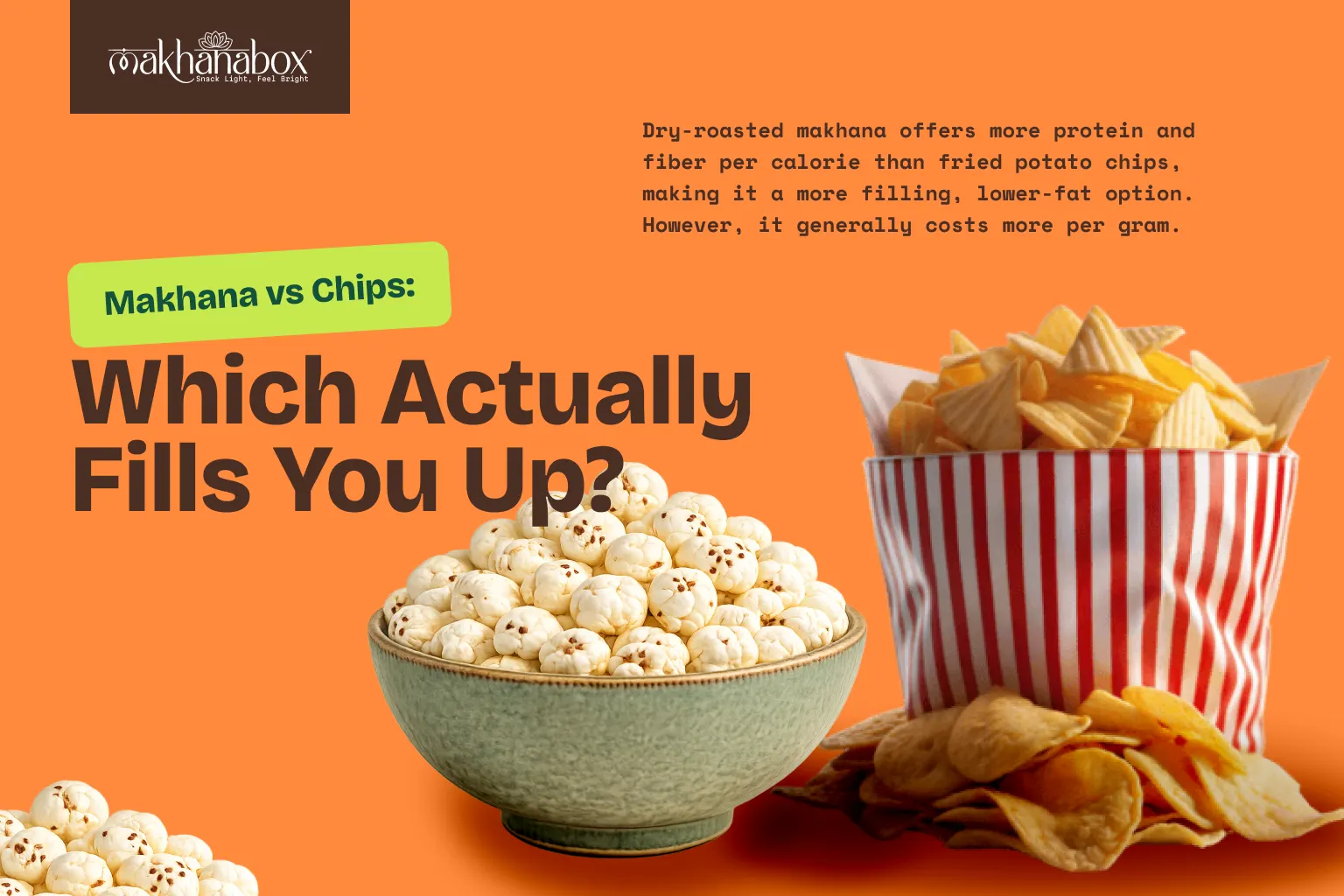
Makhana generally fills you up more efficiently than potato chips, for a straightforward reason: it's dry-roasted rather than fried, so you get more protein and fibre per calorie, without the fat load that makes chips easy to overeat. That said, makhana usually costs more per gram, and "fills you up" is partly personal — here's the honest comparison, not the marketing version.
Frying vs dry-roasting: where the real difference starts
Potato chips are, by definition, fried — sliced potato cooked in hot oil, which is where most of their calories and fat come from. Makhana is dry-roasted: the popped lotus seed goes into a hot pan or roaster with little to no oil, and any oil in a Makhana Box flavour (like Peri-Peri or Cheese & Herb) is a light finishing coat, not a cooking medium. That one process difference is the root of almost every nutritional gap between the two snacks.
Fat and sodium, side by side
Our Classic Roasted makhana carries about 0.6g of fat per 100g. A typical bag of fried potato chips runs dramatically higher — deep-frying inherently pushes fat content up, often into the range of 30–35g per 100g depending on the brand and cut. Sodium is closer, and depends heavily on the specific product: our Classic Roasted sits at 210mg per 100g and Himalayan Pink Salt at 195mg, while heavily seasoned chips can run well above that. The honest takeaway is that fat is where makhana wins decisively; sodium is a closer, label-dependent contest. Full figures are on our nutrition page.
Protein, fibre, and why they matter for feeling full
Makhana carries about 9.7g of protein per 100g against roughly 6.5g for typical potato chips — a meaningful gap, especially since it arrives with a fraction of the fat. Fibre tells a similar story: makhana's 3–3.5g per 100g on the roasted, seasoned pouches (and considerably more in raw seed form) gives it more staying power than a starchy, low-fibre chip. Protein and fibre are the two nutrients most consistently linked to feeling satisfied after eating, which is the mechanism behind "makhana fills you up" claims — it's not a mysterious property of the seed, it's fairly ordinary nutrition science.
Where chips still win, honestly
We're not going to pretend chips have no appeal. Fried food hits a specific fat-salt-crunch combination that's genuinely hard to replicate, and if that's what you're craving in the moment, a roasted snack — however well-formulated — may not scratch the same itch. Chips are also usually cheaper and more widely available. If you're choosing based purely on taste preference in a specific moment, that's a legitimate reason, and no nutrition table changes that.
The price-per-gram reality
We won't dodge this: makhana usually costs more per gram than mass-market potato chips, and there's a real reason for it rather than just brand positioning. Makhana is harvested and popped through a slower, more manual process — the seeds are hand-picked from ponds, dried, and popped in small batches, which is nothing like the highly automated potato-slicing-and-frying lines that produce most commodity chips. Raw seed cost is also higher than potatoes and cooking oil. You're paying for a more labour-intensive product, not just a "healthy" label markup — whether that trade-off is worth it to you is a personal call, and either answer is fine.
So which one actually fills you up?
For most people, gram for gram, makhana's protein-and-fibre combination edges out chips' fat-and-salt combination when it comes to genuine satiety rather than momentary craving satisfaction. But "most people" isn't "everyone," and how filling a snack feels depends on what you're craving, how much you eat, and what else you've eaten that day. Try both, in the portions you'd actually eat, and trust your own experience over anyone's blog post — including this one.
Frequently asked questions
Is makhana healthier than potato chips? By most standard measures, yes — makhana is dry-roasted rather than fried, so it carries far less fat, and it has more protein and generally more fibre per 100g than potato chips. It's still a processed, seasoned snack, not a health food free-for-all.
Does makhana fill you up more than chips? Many people find it more filling per handful because of its protein and fibre content, but satiety is genuinely individual — some people will still find a bag of chips more satisfying in the moment, especially if they're craving fat and salt specifically.
Why is makhana more expensive than chips? Makhana is hand-harvested and hand-popped in a slower, more labour-intensive process than machine-fried potato chips, and the raw seed itself costs more than commodity potatoes and oil. The higher price reflects that production reality, not just branding.
Is makhana lower in sodium than chips? Generally yes, though it depends on the specific product on both sides — a heavily salted chip brand can still out-salt a plain makhana pouch. Checking the actual label on both is worth doing rather than assuming.
Can makhana replace chips completely in my diet? It can for many snacking occasions, especially when you want something roasted rather than fried. But food preference is personal, and there's nothing wrong with chips occasionally as part of an otherwise balanced diet — this isn't a strict either/or.
About Makhana Box
We make the roasted side of this comparison, so take our framing with that in mind — but every number above matches what's on our own nutrition tables, and we'd rather you make an informed choice than an uninformed one. Browse all six flavours or check the full nutrition breakdown before you decide. Reach us anytime:
- Phone: +91 91559 97784
- Email: sales@makhanabox.com
This article is for general information and is not medical or nutritional advice. If you have a health condition, please consult a qualified professional.