
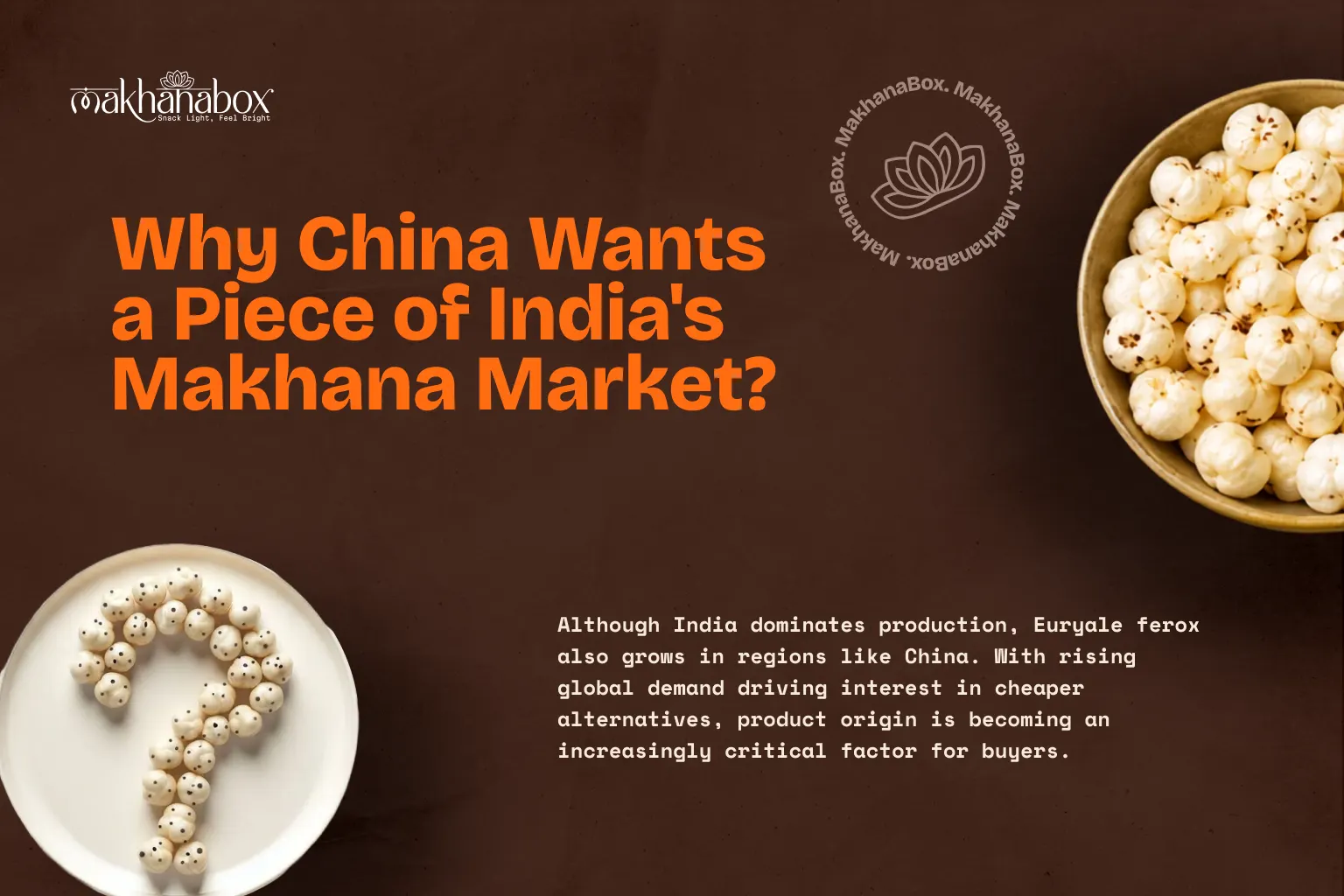
India, and specifically Bihar, is widely reported to grow and process the large majority of the world's makhana — but the plant it comes from, Euryale ferox, isn't uniquely Indian. It also grows in parts of China, and as global demand for makhana as a health-snack has climbed, interest in growing or sourcing it more cheaply elsewhere has reportedly grown along with it. That's exactly why where your makhana actually comes from is becoming a more relevant question for buyers, not less.
The same plant, a much older story in China too
Euryale ferox — the spiny aquatic plant whose seed becomes makhana — has a genuinely long history in China as well as India. There, it's traditionally known as qian shi, used for centuries in traditional Chinese medicine and in cooking, generally treated more as a medicinal or culinary ingredient than as a packaged snack food. So this isn't a case of one country recently discovering what another has always had; it's closer to two old, separate traditions built around the same seed, which happened to develop very differently — one toward a mainstream snacking product, one more rooted in traditional and medicinal use.
Where India, and Bihar, actually stand
None of that changes where the bulk of today's global snack-grade makhana supply comes from. Bihar's dominance of the makhana trade is widely reported and, as we've written about separately, commonly cited at somewhere around 80–90% of world production — a figure that varies by source and year but consistently points the same direction. That scale isn't an accident of branding; it comes from generations of growers and processors working a very specific combination of wetland geography and hand-skill that isn't easy to replicate quickly, wherever else the underlying plant happens to grow.
Why other regions are taking notice
As health-conscious snacking has turned makhana from a regional, seasonal food into something sold in supermarkets and D2C boxes nationally and internationally, the raw crop has become more commercially valuable than it once was. Some industry reporting suggests growing interest — in China and in a few other regions — in expanding cultivation of Euryale ferox or sourcing it more cheaply, drawn by that same rising demand. We'd rather flag this as a general, reported trend than claim to know the specifics of any country's production plans or export ambitions; precise figures here are hard to verify and we haven't seen reliable data to quote confidently.
What's reasonable to say is this: when a niche regional crop turns into a growing global category, competition for supply — from other regions, and eventually other countries — tends to follow. That's a normal market dynamic, not a crisis, but it does raise a real question for buyers: if makhana starts coming from more places, how do you know what you're actually getting?
The GI tag: an advantage that travelling seed doesn't erase
This is where India's 2022 Geographical Indication tag for "Mithila Makhana" matters more than it might first appear. As we cover in detail in our explainer on the GI tag, that legal status ties the name specifically to makhana grown and processed within the defined Mithila belt of Bihar — the same way "Champagne" is legally restricted to sparkling wine from that French region. It doesn't stop Euryale ferox from being grown anywhere else in the world, including China. What it does stop is anyone outside that Bihar belt from calling their product "Mithila Makhana," no matter how similar the underlying plant.
In a market where more regions may start growing the same species, that's a meaningful, verifiable line for a buyer to hold onto — a name that means something specific about where the seed actually came from, backed by law rather than just marketing copy.
Why we think this matters beyond the label
We're a small Patna-based business, not trade policy experts, and we're not going to pretend to forecast how international makhana competition plays out. But the sourcing decision in front of us is simple, and we make it deliberately: we buy raw and roasting-grade makhana from growers and processors within Bihar's own Mithila and Seemanchal belt — the same GI-tagged region — rather than chasing whatever seed is cheapest that season, wherever it comes from. You can read more about that sourcing on our About page, and see the raw, ungraded seed itself, sorted by size, on our raw makhana page. As the global market for this seed grows and diversifies, genuine regional origin isn't a marketing flourish — it's one of the few things a buyer can actually verify.
Frequently asked questions
Is makhana grown anywhere outside India? Yes. The plant behind makhana, Euryale ferox, also grows in parts of China, where it has a long history in traditional cuisine and medicine under the name qian shi. India, and Bihar specifically, is still widely reported to be the dominant source for the finished snack-grade product sold globally.
Does India still dominate the global makhana market? By most industry reporting, yes — Bihar alone is commonly cited as producing a large majority of the world's makhana. Exact market-share figures vary by source and year, so we'd treat any single precise percentage with some caution rather than as settled fact.
What does the GI tag have to do with competition from other countries? The GI tag legally ties the name "Mithila Makhana" to makhana genuinely grown and processed in that specific Bihar region. Even if Euryale ferox is cultivated elsewhere, including in China, that produce cannot legally be sold under the Mithila Makhana name — origin, not just species, is what the tag protects.
Is Makhana Box's makhana sourced from the GI-tagged region? Yes. We buy raw and roasting-grade makhana from growers and processors within Bihar's Mithila and Seemanchal belt, the same region the GI tag covers, rather than from an anonymous national or international supply chain.
Why does origin matter when buying makhana? Because makhana's quality, tradition, and much of its story are tied to how and where it's actually grown and processed. As global demand rises and more regions take interest in the crop, knowing your seed traces back to a genuine, established growing belt becomes a real quality signal, not just a nice-to-have detail.
About Makhana Box
We source raw and roasting-grade makhana from growers and processors within Bihar's Mithila and Seemanchal belt — the GI-tagged region this whole conversation is about — rather than an anonymous, unverified supply chain. Read the full sourcing story on our About page, or browse the raw, ungraded seed by size on our raw makhana page. Reach us anytime:
- Phone: +91 91559 97784
- Email: sales@makhanabox.com
This article reflects general industry reporting and trends, not official market data or investment guidance.