
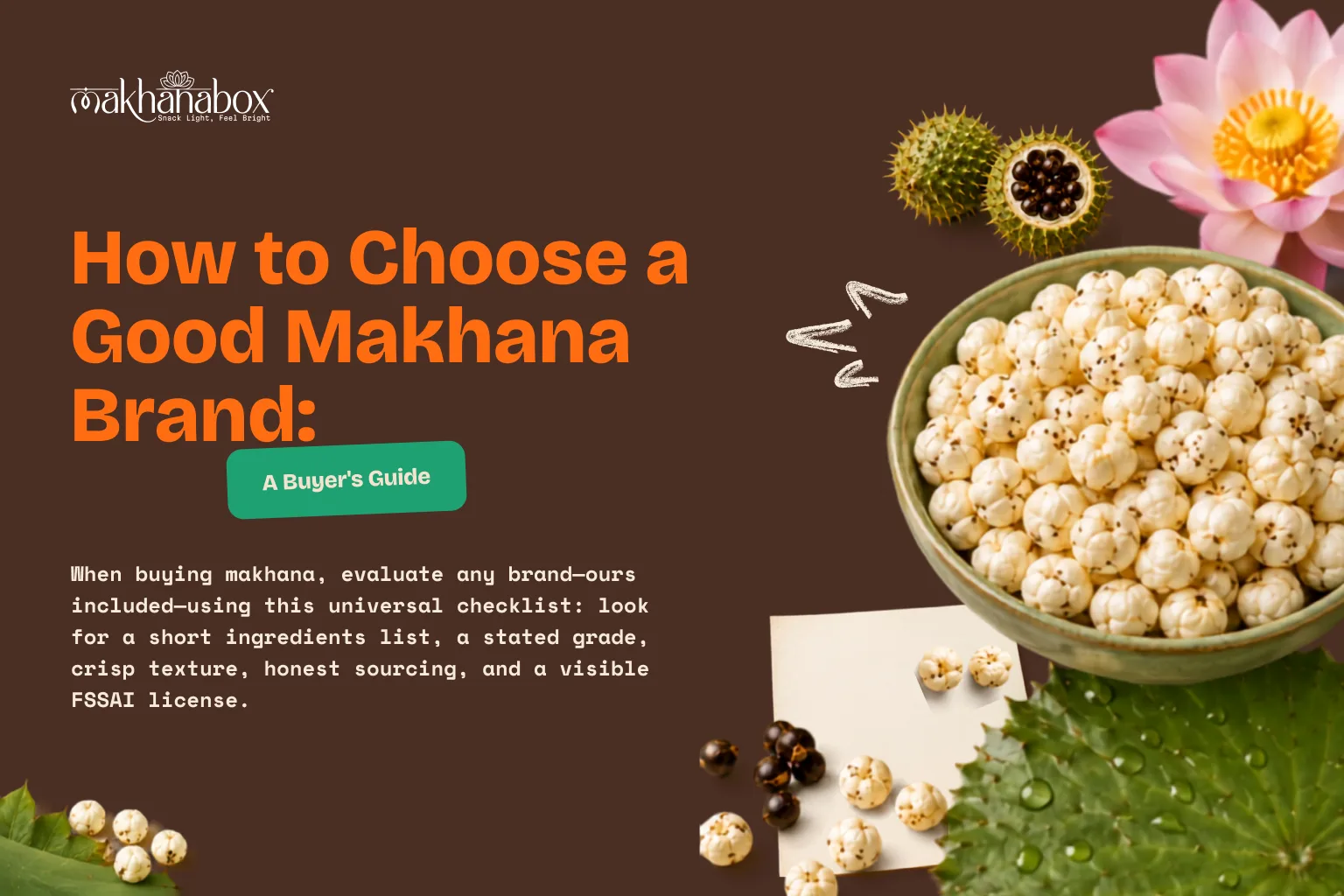
Good makhana has a short ingredients list, a stated grade, a fresh crisp texture, honest sourcing claims, and a visible FSSAI licence number — check those five things on any brand's site or packaging before you buy, ours included. This isn't a ranked "top brands" list; it's the checklist we'd want a friend to use, written so you can apply it anywhere.
1. Read the ingredients list — it should be short
Plain roasted or raw makhana needs almost nothing besides the seed itself: maybe salt, maybe a spice blend for a flavoured variety, sometimes a light oil coating. It's a naturally low-moisture food, which is exactly why it doesn't need the preservatives or anti-caking agents you'd expect on something more perishable. If a pouch's ingredient list runs long with stabilisers, artificial flavour compounds, or preservatives you can't place, that's usually a sign of a lower-effort product covering for stale stock or a cheaper base ingredient, not a necessary safety measure. Compare it against our own nutrition breakdown if you want a concrete example of what a short list looks like.
2. Check whether the seller mentions grade or size at all
Raw makhana is genuinely graded by size — a traditional unit called "suta," running roughly 3 (smallest) through 7 (largest) — and grade affects both use and, in a fair market, price. A seller who tells you the grade is telling you they know their own supply chain well enough to grade it consistently; a seller who only says "premium quality" with no size or grade mentioned anywhere is giving you a marketing adjective instead of a fact you can check. See our suta grading guide if you want the full picture on what each grade actually means.
3. Judge freshness by smell and texture, not just the sell-by date
Fresh roasted makhana should smell lightly toasted and nutty, not oily, musty, or flat. Texturally, it should have a genuine crisp snap — if a piece feels chewy or soft straight out of a sealed pouch, that's a real freshness problem, not a quirk of the brand's style. A seller who states a roast date or pack date (not just a generic best-before stamped months out) is being more transparent than one who doesn't, since freshness genuinely fades over weeks, not months, once a pouch is opened.
4. Look for specific sourcing claims, not vague ones
"Sourced from India" is true of almost every makhana brand and tells you nothing. A brand that names an actual region — Mithila, Bihar's Darbhanga or Madhubani belt, or similar — is making a claim you can at least cross-check, and one that's more likely to reflect real sourcing relationships rather than a bought-in bulk supply of unknown origin. It's also worth knowing that "Mithila Makhana" carries a real, legal Geographical Indication tag from the Government of India as of 2022 — see our GI tag explainer for what that protection actually means and why origin claims matter here specifically.
5. Confirm there's a real, visible FSSAI licence number
Any legitimate Indian food business needs an FSSAI licence, and a business that has one usually shows the number somewhere — a footer, a contact page, or the packaging itself — rather than just displaying a generic "quality assured" badge with no number attached to check. A badge image alone isn't verification; a specific licence number is closer to one. It's a small detail, but it's one of the easier things to actually confirm before you buy.
Where does price fit into all this?
Price is a weaker signal than the five things above — it correlates with quality but isn't proof of it on its own. A very cheap raw makhana relative to typical grade pricing can indicate an older batch or a smaller grade sold without saying so; a very expensive one with no explanation of what you're paying extra for (bigger grade, extra processing, gifting-grade presentation) is just as worth questioning. Our own price guide walks through what genuinely moves the cost of makhana up or down, if you want the fuller picture before comparing across sellers.
Frequently asked questions
Is more expensive makhana always better? Not automatically. Price should track something real — grade/size, whether it's roasted or raw, how it's packed — not just a brand markup. Check what a seller says about grade and sourcing before assuming a higher price means better quality.
How can I tell if makhana has gone stale? Stale makhana loses its crisp snap and turns chewy or soft, and it often smells faintly musty or oily rather than lightly toasted. If a pouch feels soft straight out of the packet, that's a freshness problem, not a texture quirk.
Does a bigger grade always mean better makhana? Bigger, more expensive grades (higher suta numbers) generally look more premium and are prized for gifting or presentation, but the "best" grade depends on what you're using it for — smaller grades are perfectly good, not inferior, for flour or everyday cooking.
What's a red flag when buying makhana online? Vague sourcing claims with no region mentioned, no visible FSSAI licence number anywhere on the site or packaging, and an ingredients list padded with additives a naturally simple, low-moisture snack shouldn't need.
About Makhana Box
We obviously think we hold up well against this checklist — but the point of writing it isn't to tell you to buy from us specifically, it's so you have real questions to ask any seller, ours included. Come check our own raw makhana grades and flavours against this list yourself, or just ask us directly. Reach us anytime:
- Phone: +91 91559 97784
- Email: sales@makhanabox.com
This article reflects general buying guidance based on common quality and transparency signals, not a certification or endorsement of any specific brand.