
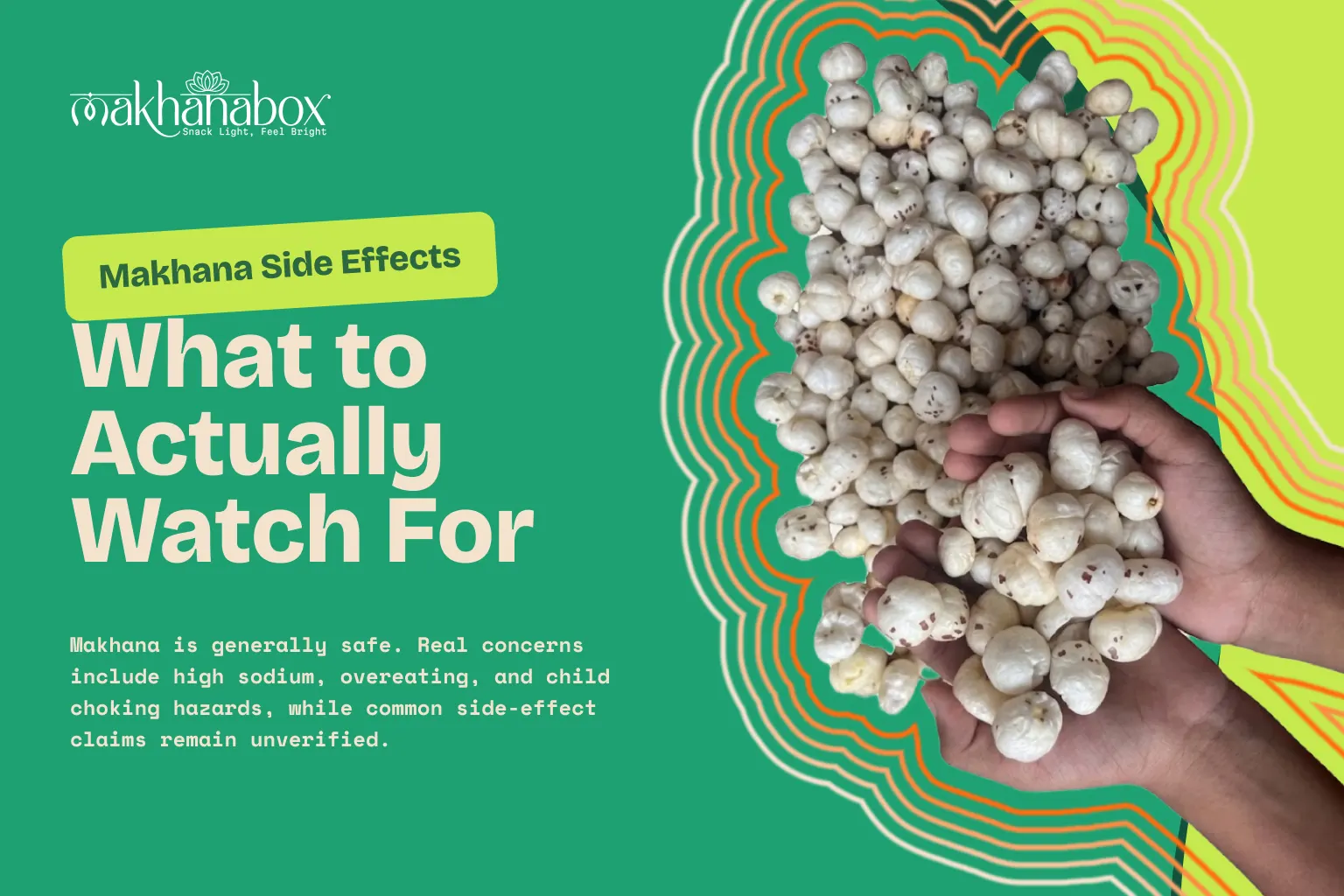
For most healthy people, makhana doesn't have meaningful side effects — but a few real, specific things are worth knowing (sodium in flavoured packs, overeating discomfort, choking risk for young children), and a few commonly repeated claims (oxalates, allergy cross-reactivity, medication interactions) don't hold up when we actually went looking for the source. We'd rather tell you which is which than repeat whatever's easiest to find.
What's real: sodium in flavoured, seasoned varieties
Plain, unsalted raw makhana carries almost no sodium at all. Once it's roasted and seasoned, that changes — our own Classic Roasted comes to 210mg of sodium per 100g, and spicier flavours like Peri-Peri or Tangy Masala run higher, into the 340-380mg range per 100g. That's still modest next to a typical bag of chips, but it's not zero, and it's the one genuinely quantifiable dietary consideration here. If sodium intake is something you or a doctor are watching, a plainer flavour like Classic Roasted or Himalayan Pink Salt is the more sensible everyday pick — full numbers are on each flavour's page.
What's real: overeating discomfort
Eating a large amount of any fibre- and carbohydrate-dense whole food in one sitting can cause bloating or a heavy feeling — makhana isn't an exception, and isn't especially prone to it either. This is why a realistic snack portion (roughly 20-30g, a small handful) makes more sense than treating a full 100g pouch as one sitting. We cover portioning in more detail in is it okay to eat makhana every day.
What's real: choking risk for young children
This one's serious enough that we've written about it separately in full. Whole roasted makhana is firm and crunchy, and that combination is a genuine choking hazard for infants and young toddlers who aren't yet reliably chewing solid textures. It's not a side effect of eating makhana as an adult — it's specifically about how it's introduced to very young children. See is makhana safe for babies for the full, careful answer.
What doesn't hold up: "makhana is high in oxalates"
This claim shows up often enough that it's worth addressing directly — and we can't verify it. The oxalate figure that gets repeated for "makhana" traces back to USDA nutrition data for dried lotus seed, Nelumbo nucifera — a different plant from the actual makhana seed, Euryale ferox. We've run into this exact mix-up before while researching makhana's nutrition data, and it's worth being consistent: if we won't quote lotus-seed vitamin data as makhana data in one article, we're not going to quote lotus-seed oxalate data as makhana data in this one either. We haven't found a reliably sourced oxalate measurement for the real seed. If oxalate intake matters for a specific health condition you're managing, that's a conversation for your doctor — not a number we're willing to print without a real source behind it.
What doesn't hold up: allergy cross-reactivity
Makhana is a seed from an aquatic plant, not a tree nut, and we found no published medical case reports describing makhana-specific allergic reactions. That's not a guarantee no one could ever react to it — any food can trigger a reaction in a specific individual — but there's no evidence makhana behaves like a common or notable allergen the way tree nuts, shellfish, or dairy do. If you have a known food allergy and are trying makhana for the first time, the standard sensible approach applies: a small amount first, and a call to your doctor if you have a strong reason for concern.
What doesn't hold up: blood thinner interactions and kidney warnings
Two more claims we specifically checked and couldn't substantiate. We found nothing in drug-interaction literature suggesting makhana affects blood-thinning medication, and no documented mechanism for it. On kidney health specifically, the "watch your potassium" warning some sources apply to makhana looks overstated once you actually run the numbers: a realistic 30g serving carries roughly 100-150mg of potassium, below the level typically flagged as "high potassium" in kidney-diet guidance. If you have a diagnosed condition where either of these genuinely matters for you, your own doctor's guidance always overrides a general article — but we're not going to manufacture a warning that the evidence doesn't support.
The honest summary
Makhana's real caveats are ordinary, portion-and-label-reading ones: check sodium on flavoured packs if that matters to you, eat a sensible portion rather than a whole pouch at once, and don't give whole pieces to young children. The scarier-sounding claims that circulate — oxalates, allergy risk, drug interactions, kidney danger — don't hold up to a real source check, and we'd rather say that plainly than let an unverified claim sit unchallenged just because it's already out there.
Frequently asked questions
Does makhana have any real side effects? For most healthy people, no serious ones. The genuine, quantifiable caveat is sodium in flavoured, seasoned varieties (roughly 200mg per 100g on our own pouches), and mild digestive discomfort from eating a large amount at once, the same as with most fibre-rich whole foods. Neither is a reason to avoid makhana — they're portion and label-reading considerations, not warnings.
Is makhana high in oxalates? We can't confirm that claim, and we've looked closely. The oxalate figure that circulates online for "makhana" traces back to USDA data for dried lotus seed (Nelumbo nucifera) — a different plant from actual makhana (Euryale ferox). We haven't found a reliably sourced oxalate measurement for the real makhana seed, so rather than repeat an unverified number, we're flagging that it's unverified.
Can makhana cause an allergic reaction? It's botanically a seed, not a tree nut, and we found no published case reports of makhana-specific allergic reactions in medical literature. That doesn't make it impossible for any individual to react to any food, but there's no evidence makhana is a notable or common allergen the way tree nuts or shellfish are.
Does makhana interact with medications like blood thinners? We found no evidence of this in drug-interaction literature, and no plausible mechanism has been documented. If you're on any medication and have a specific concern about a food interaction, your doctor or pharmacist is the right source, not a general claim repeated online without a citation.
Is makhana bad for kidney health because of potassium? Based on the numbers, this looks overstated. A realistic 30g makhana serving carries roughly 100-150mg of potassium — below the threshold typically used to flag a food as "high potassium" in kidney-diet guidance. That said, anyone with diagnosed kidney disease should get portion guidance from their own doctor or renal dietitian rather than a general blog post.
About Makhana Box
We'd rather publish "we couldn't verify that" than repeat a scary-sounding claim because it's already common. For the full, verified nutrition picture, see our vitamin & mineral breakdown and nutrition & benefits page. Reach us anytime:
- Phone: +91 91559 97784
- Email: sales@makhanabox.com
This article is for general information and is not medical advice. If you have a specific health condition, allergy concern, or are on medication, please consult a qualified professional rather than relying on this or any general article.