
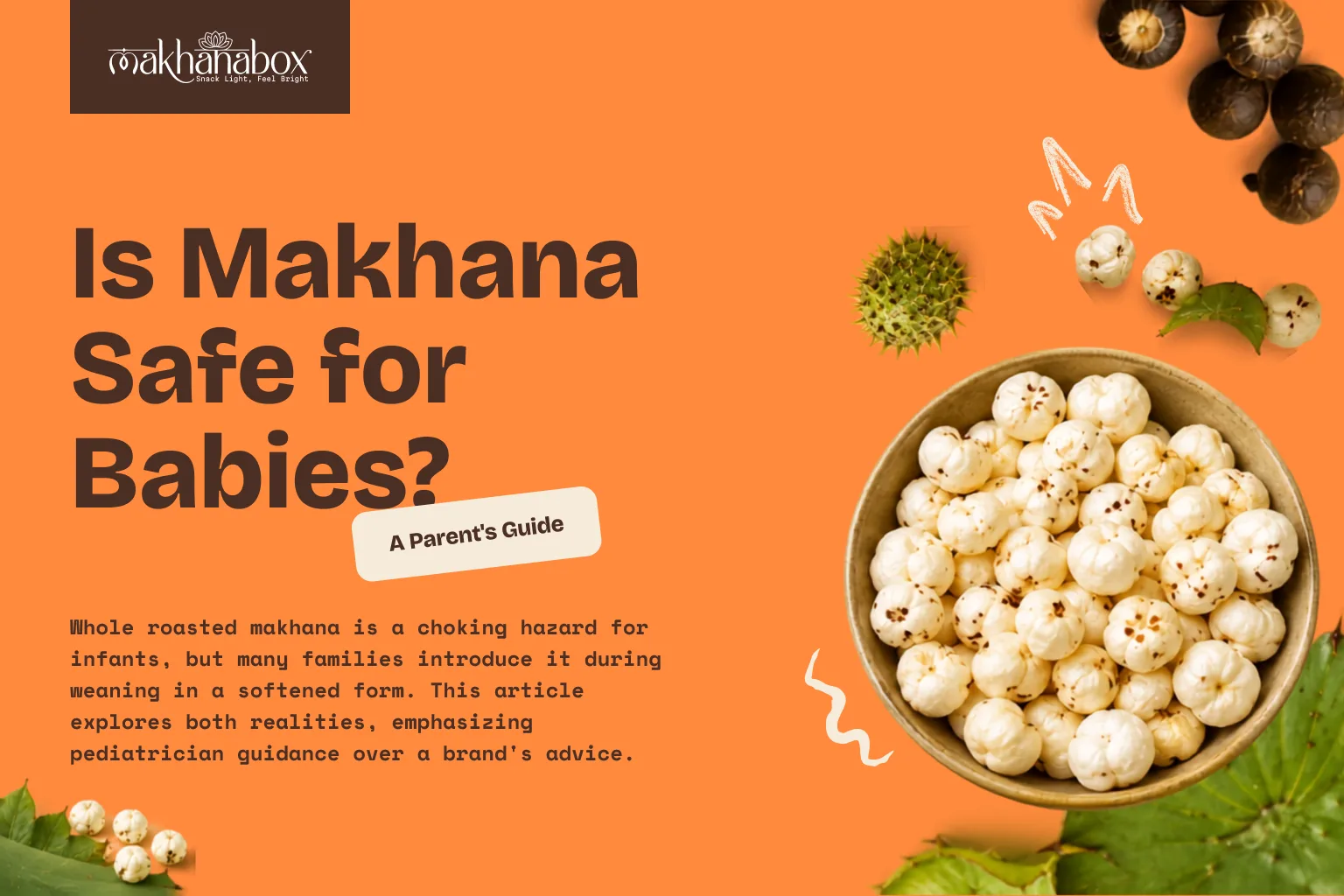
Whole roasted makhana is not safe to hand directly to a baby — its firm, crunchy texture makes it a real choking hazard for infants — but that isn't the end of the story. Many families do work makhana into a baby's diet at the weaning stage, just in a much softer, unrecognisable form, and always alongside their pediatrician's guidance rather than a snack brand's say-so. This article exists to be honest about both halves of that.
The direct answer, in plain terms
If the question is "can I give my baby a handful of roasted makhana the way I'd give it to myself," the answer is no. It's a firm, crunchy, small, roundish food, and that combination sits squarely in the category of foods considered choking risks for infants and young toddlers. If the question is "can makhana ever be part of a baby's food," the honest answer is that some families do use it, but in forms that don't resemble the snack pouch at all — ground to a powder, or cooked until soft — and typically after a conversation with their child's doctor about timing and readiness. We're a snack company, and we'd rather say that plainly than round it up into something friendlier.
Why the choking risk is real, not a formality
This isn't a boilerplate warning we're adding for legal cover. Popped makhana holds its shape and crunch even after roasting — that's the entire appeal of it as a snack for people who can chew properly. Infants and young babies don't have that chewing and swallowing coordination yet, and a firm, dome-shaped piece that's roughly the size and shape to lodge in a small airway is a real hazard, the same way whole nuts, whole grapes, or hard chunks of raw carrot are for this age group. Please don't offer whole roasted makhana — plain or flavoured — to an infant or a baby who isn't yet reliably managing solid textures, and supervise closely around any new food regardless.
How it's more commonly introduced instead
Where makhana does show up for babies, it's usually in one of two forms, and both are about changing the texture entirely rather than just adding makhana to the diet. The first is grinding roasted (or well-dried) makhana into a fine, soft powder and stirring a small amount into something the baby is already eating comfortably, like kheer or a porridge — this is a fairly traditional approach in parts of India, where makhana kheer itself is a common festival dish, adapted down for a much younger palate and much softer texture. The second is cooking makhana down until it's genuinely soft, then mashing it rather than serving it whole. Neither of these is a guarantee of safety on its own — a powder that's too coarse, or makhana that isn't cooked soft enough, can still carry some of the same texture risk — which is exactly why we keep coming back to checking with a pediatrician rather than treating either method as a settled shortcut.
Why we won't give you an age
We know parents often want a specific number here, and we're deliberately not giving one. Weaning timelines, readiness for new textures, and individual allergy risk all vary genuinely from baby to baby — general guidance exists from pediatric and public health bodies, and it's worth reading, but applying it to your specific child is exactly the judgement call a pediatrician is trained to make and a snack blog isn't. If you take one thing from this article, we'd rather it be "ask your baby's doctor before introducing this" than any age we could print here.
Allergies and introducing anything new
Makhana is the popped seed of an aquatic plant (Euryale ferox), which makes it botanically a seed rather than a tree nut — so it isn't automatically covered by a tree nut allergy diagnosis. That's a useful fact, but it isn't a safety guarantee: allergies are individual, cross-contamination can occur during processing, and any new food introduced during weaning should be brought in one at a time, in a small amount, with you watching for a reaction afterwards. If there's a family history of food allergies, or your baby has had a reaction to another food before, talk to your pediatrician before trying makhana in any form.
The bottom line for parents
Don't hand a baby whole roasted makhana as a snack — the choking risk is real and not worth taking. If you're curious about makhana as part of a baby's weaning diet in a ground or well-cooked form, that's a conversation to have with your pediatrician first, who knows your baby's specific stage, allergy history, and readiness for new textures far better than any general article can. We'd rather lose a sale than have you skip that conversation.
Frequently asked questions
Can babies eat makhana? Only with real caution, and ideally after checking with your pediatrician. Whole roasted makhana is firm and crunchy, which makes it a genuine choking hazard for infants and young babies — it is not something to hand a baby whole. Some families introduce makhana to babies in a very different form instead: ground into a fine powder and mixed into kheer or porridge, or cooked down soft and mashed, rather than offered as a snack.
Is whole roasted makhana a choking hazard for babies? Yes. Its firm, crunchy texture and small, roundish size are exactly the characteristics that make a food a choking risk for infants and young toddlers who don't yet chew and swallow reliably. Treat whole roasted makhana the way you'd treat whole nuts or hard raw vegetable pieces around a baby, and don't offer it as a stand-alone snack to an infant.
What's a safer way to introduce makhana to a baby? The approaches families most commonly use are grinding roasted makhana into a fine, soft powder stirred into kheer, porridge or another semi-liquid food the baby already eats, or cooking it down until it's soft enough to mash. Both change the texture completely, which is the point — the goal is removing the choking risk, not just getting makhana into the bowl.
At what age can babies start eating makhana? We're not going to put a specific age on this, and we'd be cautious of any snack brand that does. Weaning timelines and readiness for new textures genuinely vary from baby to baby, and the right source for that guidance is your pediatrician or a recognised health authority — not a food company's blog post.
Is makhana a common allergy risk for babies? Makhana is botanically a seed rather than a tree nut, so it isn't automatically covered by a tree nut allergy, but that doesn't make it risk-free for every baby. As with any new food introduced during weaning, bring it in one at a time, in a small amount, and watch for a reaction — and talk to your pediatrician first if there's any family history of food allergies.
About Makhana Box
We make a roasted, ready-to-eat snack built for people who can chew and swallow it safely — it isn't formulated or positioned as an infant food. If you're after guidance for older children's snacking instead, our piece on makhana for kids' lunchboxes covers that different age group and question. For the underlying nutrition profile that makes makhana worth considering at all once a doctor gives the go-ahead, see health benefits. And if you'd rather source plain, unroasted seed to prepare yourself at home — including grinding it down for a baby's kheer, under your pediatrician's guidance — our raw makhana page has all five grades. Reach us anytime:
- Phone: +91 91559 97784
- Email: sales@makhanabox.com
This article is for general information only and is not medical, nutritional, or infant feeding advice. Please consult your baby's pediatrician before introducing makhana or any new solid food, particularly regarding choking risk, readiness, and allergies — every baby's weaning timeline and allergy risk profile is different.