
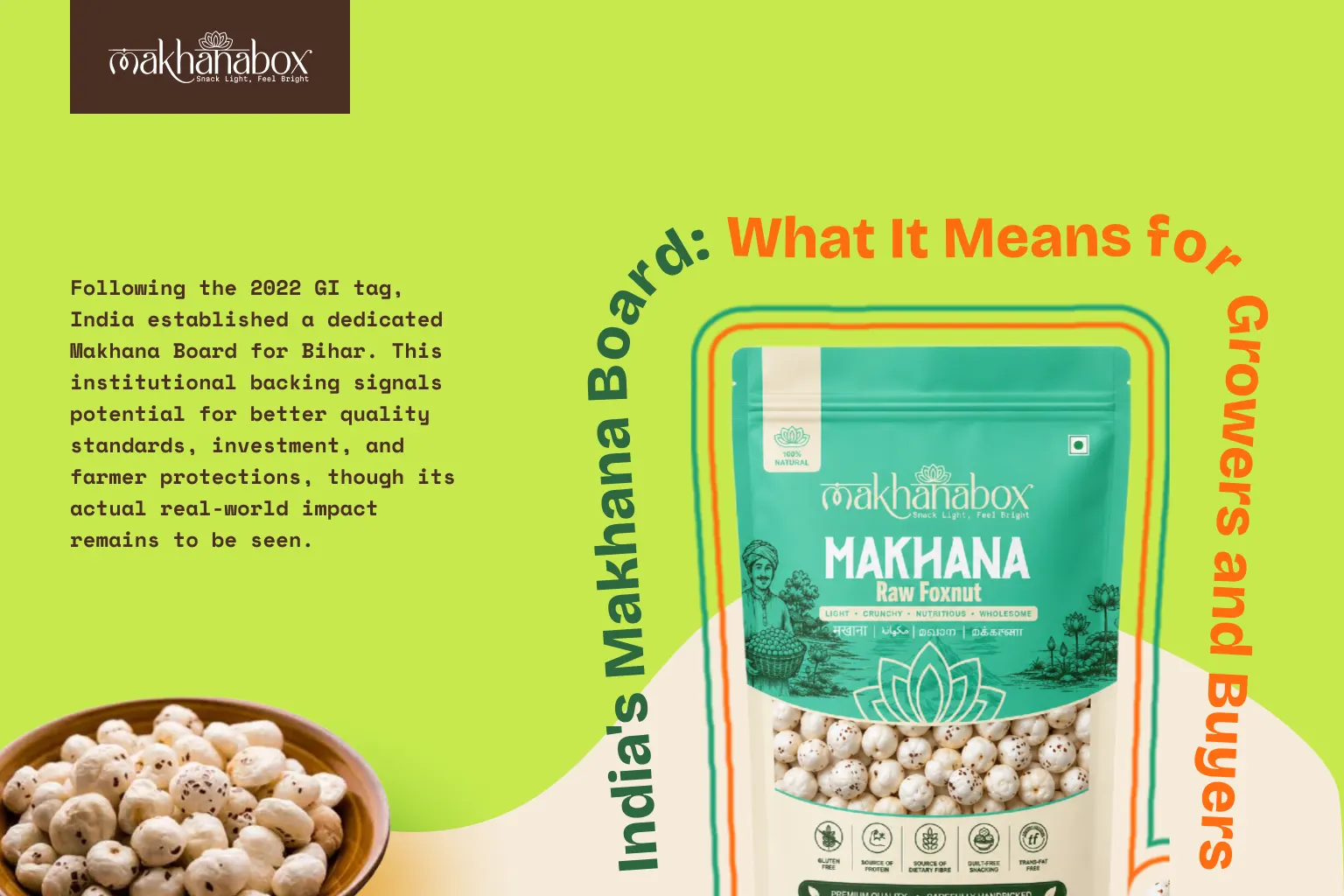
India has moved to set up a dedicated Makhana Board focused on Bihar's makhana sector, building on the momentum the 2022 GI tag started. In plain terms, that kind of institutional backing generally points toward better quality standards, more investment in the sector, and stronger protections for the farmers who grow it — though how much of that actually materializes, and how quickly, is genuinely worth watching rather than assuming.
What's been announced, stated plainly
The Indian government has announced the creation of a Makhana Board dedicated to Bihar, with goals commonly described around improving production, processing, value addition, quality standards, and market access for the state's makhana growers, including support for farmer producer organizations. We're stating that general direction plainly because it reflects a real, publicly reported government initiative — but we're deliberately not quoting specific budget figures, timelines, or organizational details here, because those particulars can change as an institution is actually stood up, and we'd rather not state numbers we can't confirm are still accurate by the time you're reading this.
Building on what the GI tag started
This isn't happening in isolation. As we've written about in our explainer on the Mithila Makhana GI tag, 2022 marked a formal, legal recognition that makhana grown in Bihar's Mithila belt is a distinct, geographically rooted product worth protecting. A dedicated board is a natural next step in the same direction — where a GI tag protects a name, a board is generally aimed at the broader work of building an industry around that recognition: standards, infrastructure, farmer support, and market development. One is a legal foundation; the other, if it plays out as intended, is the institutional effort to build on it.
What institutional support generally means for an industry
We'd rather explain this in general terms than overstate what we know about makhana specifically. When a government sets up a dedicated board or similar body for an agricultural sector, the typical aims tend to fall into a few buckets: clearer quality and processing standards that buyers can rely on, easier access to investment and modern infrastructure, better organization of farmers into producer groups with more collective bargaining power, and support for market access — including, potentially, export markets. None of that happens automatically or immediately just because a board is announced; execution, funding, and time all matter, and outcomes vary a lot by sector and by how the institution is actually run. We'd treat this as a meaningful signal of intent and direction, not a guarantee of specific results.
What it could mean for buyers
For someone simply buying and eating makhana, the honest answer is: probably not much changes immediately, and we wouldn't want to suggest otherwise. Over a longer horizon, if this kind of institutional support genuinely improves quality standards, processing consistency, and farmer stability across the sector, buyers would likely see the benefit indirectly — a more consistent, better-supported supply chain behind the product, rather than a dramatic shift in what shows up in a pack. It's also unlikely, on its own, to change the underlying labour- and weather-driven cost structure that makes good makhana genuinely expensive to produce in the first place.
Where we stand on this
We're a small business, not a policy analyst, and we're not going to pretend to predict exactly how this plays out. What we can say is that we already source from within the same Bihar belt this kind of institutional effort is aimed at supporting — you can read more about that on our About page. If quality standards and farmer support genuinely strengthen in that region over time, that's a good outcome for growers and for anyone who cares about where their food actually comes from, us included.
Frequently asked questions
What is India's Makhana Board? It's a dedicated institutional body announced by the Indian government, aimed at Bihar's makhana sector — generally described around goals like improving production, processing, value addition, quality standards, and market access for growers. As with any newly announced institution, exactly how it's structured and how quickly it becomes fully operational is worth following rather than assuming.
How does the Makhana Board relate to the 2022 GI tag? It builds on the same recognition the GI tag established — that Mithila Makhana is a distinct, regionally rooted product worth protecting and developing. Where the GI tag is a legal protection for the name, a dedicated board is a broader institutional push covering standards, farmer support, and market development, not just naming rights.
Does government support mean makhana prices will go down? Not necessarily, and we wouldn't want to overpromise that. Institutional support more commonly aims at things like better quality standards, more consistent supply, and stronger farmer protections rather than directly lowering consumer prices — the underlying labour- and weather-driven cost structure we've written about separately doesn't disappear because of a new board.
What does a government board generally do for an agricultural sector? Typically, some mix of setting or promoting quality and processing standards, supporting farmer producer organizations, helping with market access and price stability, and channeling investment toward the sector. How much of that materializes, and how fast, varies a great deal by sector and isn't something we'd want to predict specifically for makhana.
Does Makhana Box benefit directly from the Makhana Board? Not in any special or exclusive way — we're a small D2C business, not a government-linked entity. Like any buyer sourcing from Bihar's makhana belt, we'd expect to benefit indirectly if institutional support genuinely improves quality standards and grower stability over time, the same as any other buyer in the region would.
About Makhana Box
We source from the same Bihar growing belt this kind of institutional support is aimed at — not because of the board, but because that's genuinely where good makhana comes from. Read our full sourcing story on the About page. Reach us anytime:
- Phone: +91 91559 97784
- Email: sales@makhanabox.com
This article reflects general industry reporting and trends, not official government policy documentation or investment guidance. For authoritative details, consult official government sources.