
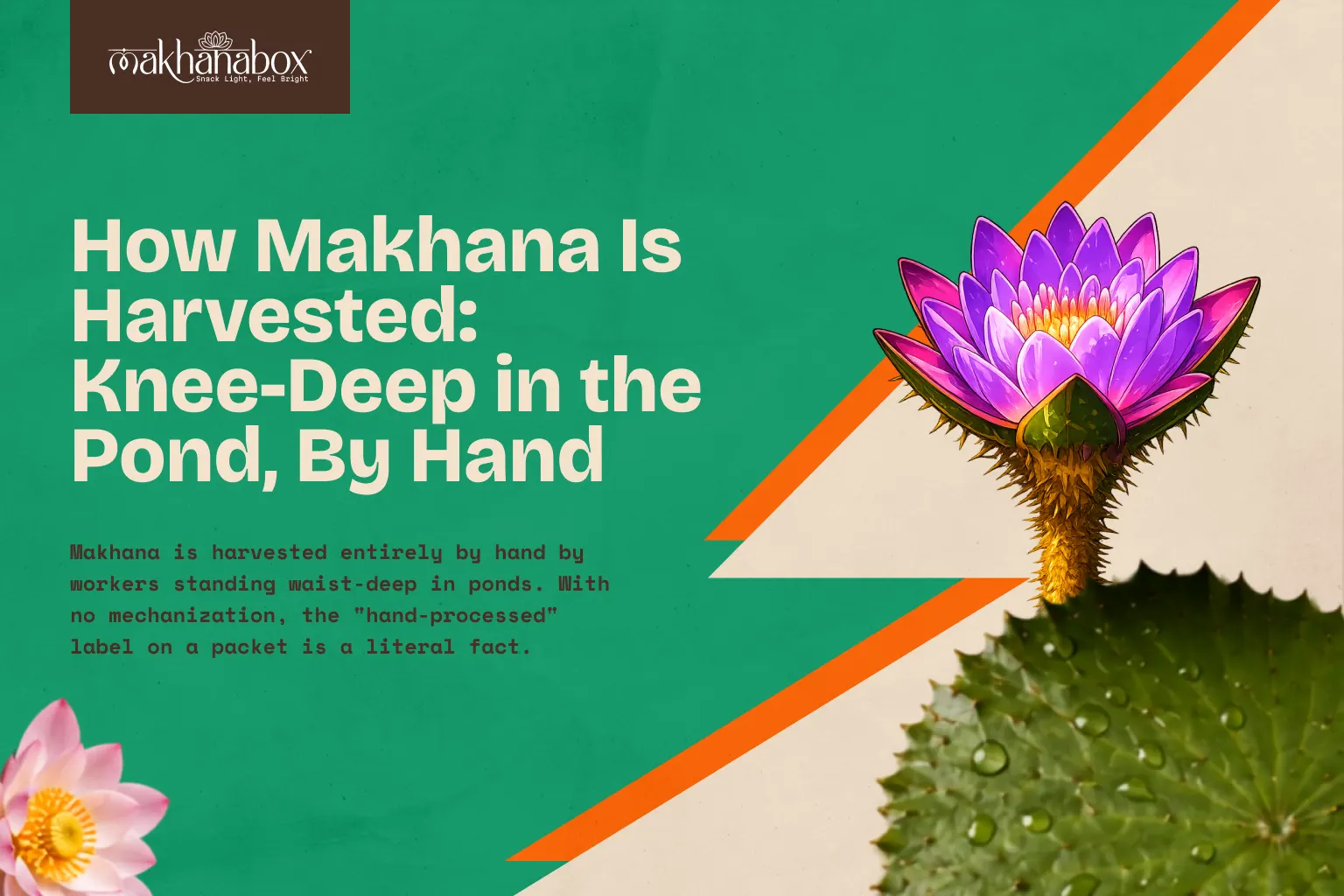
Makhana isn't picked from a field or shaken off a tree — it's pulled by hand out of shallow ponds and wetlands, usually with a worker standing waist-deep in the water to reach the ripe seed pods. There's no combine harvester, no mechanized net, no shortcut. That single fact is worth sitting with before you open your next pack, because it's the honest reason "hand-processed" on a makhana label isn't just a nice phrase.
A pond, not a field
Makhana grows on the prickly water lily, Euryale ferox, an aquatic plant that lives in shallow, still water — the kind of ponds and wetlands common across North Bihar's Mithila and Seemanchal regions, where the overwhelming majority of the world's makhana comes from. That single fact shapes everything about how it's harvested. You can't drive equipment across a pond. You can't run a mechanical picker through standing water tangled with a famously spiny, thorny plant. Whatever gets the seed pods out has to go in on foot.
Waist-deep, by hand, no machines
Come harvest season, that's exactly what happens. Workers wade into the ponds — often waist-deep, sometimes deeper depending on the water level that year — and pull the ripe seed pods out by hand, one at a time. It's slow, repetitive, physical work, done standing in water for hours at a stretch, and it has to happen during a specific window in the season when the pods are ready. There isn't a faster version of this step. It's the same basic method growers have used for generations, because the plant and the terrain haven't given anyone a mechanized alternative.
Cracking the pods on the spot
The pods don't get shipped out whole. They're cracked open right there, at the water's edge, to get at the raw seed packed inside — and only then carried out of the pond for drying. That raw seed is the starting point for everything that happens afterward: sun-drying, sieving into suta size grades, popping over heat, and eventually packing. We walk through those later steps in more detail on how we process raw makhana — but every one of them starts from a seed that a person pulled out of a pond by hand.
The honest part: this work is hard
We'd rather not dress this up. Wading through a pond for hours, harvesting a spiny aquatic plant by hand, in season, is genuinely demanding physical labour — and it's worth saying plainly rather than turning it into a romantic image. It's also seasonal work that supports a real number of livelihoods across the growing belt, and it's the reason the raw seed has real cost attached to it before it's even dried, let alone graded or roasted. When you see "small-batch" or "hand-processed" describing a food, it's fair to ask whether that's a marketing phrase or a literal description. For makhana, at this stage, it's literal — there simply isn't a version of this harvest that skips the wading and the hand-pulling.
Why this matters once it reaches your kitchen
Understanding the harvest changes how you read the rest of the supply chain. Every grade we sell on raw makhana — from the smallest flour-grinding grade to the largest premium gifting grade — began as a pod pulled out of a pond by hand, weeks or months before it reaches a sieve, let alone a pack. It's also part of why we buy from growers and processors in that same belt rather than from an anonymous bulk supplier, something we go into more on our story. The seed doesn't change species or quality between the pond and your pack — what changes is drying, grading, and popping, all covered on the process page.
Frequently asked questions
Is makhana harvesting done by machine? No. There's no mechanized way to pull makhana pods from the water — workers wade into the ponds, often waist-deep, and gather the ripe pods by hand. It's the same basic method it's always been.
Where is makhana harvested? Primarily from the shallow ponds and wetlands of North Bihar, especially the Mithila and Seemanchal regions, where the prickly water lily that produces makhana is grown and gathered in large numbers.
What happens to the pods right after they're pulled from the pond? They're cracked open on the spot to get at the raw seed inside, then carried out of the water for drying. Everything that happens later — drying, grading, popping, packing — starts from that raw seed.
Is hand-harvesting why makhana costs more than some other snacks? It's a real factor. Manual, seasonal, physically demanding labour with no mechanized shortcut adds real cost and time compared to a fully machine-harvested crop, and that's reflected in the price of the raw seed before it's even processed.
About Makhana Box
We buy from growers and processors in Bihar's makhana belt rather than an anonymous bulk supplier, which is part of what "small-batch" means when we use it — see our full story on about us, and the rest of the journey from harvest to pack on how we process. Reach us anytime:
- Phone: +91 91559 97784
- Email: sales@makhanabox.com
This article describes general practice in makhana cultivation and harvesting and may vary by grower, region, and season.