
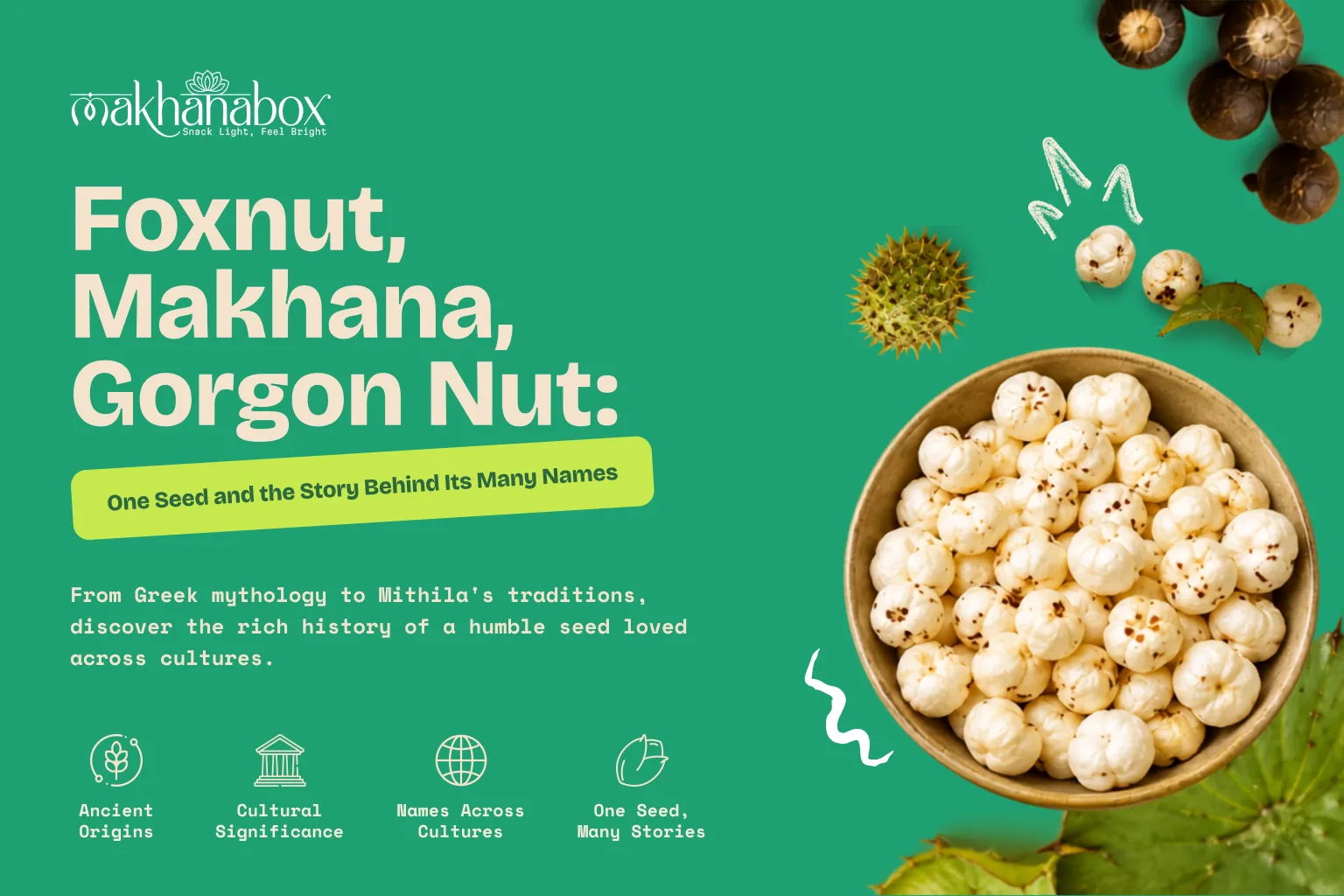
Here's something most people who snack on makhana never learn: the plant it comes from is named after a monster from Greek mythology. That single fact explains a lot about why the same little white puff turns up labelled as "foxnut," "makhana," "gorgon nut," and a handful of other names — and whether those names mean different things. This is the question answered through its history rather than a dictionary. (Want the fuller picture beyond just the names — botany, sourcing, nutrition, how it's made? See our complete makhana guide.)
The one-line answer, then the interesting part
Foxnut and makhana are the same food. They aren't two products, two grades, or two species — they're two names, from two languages, for the seed of a single aquatic plant. What's worth your time is why one humble seed accumulated so many names in the first place, because the answer runs through Greek mythology, ancient Chinese ponds, and the wedding tables of Bihar.
"Euryale": the seed named after a Gorgon
The plant's botanical name is Euryale ferox, formally described by the botanist Richard Anthony Salisbury in 1805. Both halves of that name are doing storytelling work.
Euryale was one of the three Gorgon sisters of Greek myth — Stheno, Euryale, and the famous Medusa — monstrous figures said to turn onlookers to stone. When botanists name a genus after a Gorgon, they're usually reacting to something fearsome about the plant, and ferox gives it away: it's Latin for "fierce." Anyone who has handled the living plant understands why. Euryale ferox is aggressively spiny — armoured leaves, thorny stalks, prickles almost everywhere — which is exactly why one of its plain-English names is "prickly water lily."
So the English name "gorgon nut" isn't random or marketing fluff. It's a direct descendant of that mythological, fierce-and-thorny botanical naming. Every time someone calls makhana a "gorgon nut," they're quietly invoking a Greek monster.
Where "makhana" comes from — and why it's the name that stuck
In India, none of that Greek backstory matters, because the seed already had a name and a place in daily life: makhana, the Hindi term understood across most of the country.
What makes "makhana" more than just a label is how deep it sits in the culture of Mithila, the region of north Bihar where most of the world's makhana is grown. There, it isn't only a snack — it appears in weddings, in religious offerings, and as prasad offered to deities. A local saying captures the pride: you'll find makhana either in heaven or in Mithila. When a food is woven into a region's rituals like that, its everyday name tends to win out over any imported botanical or English term — which is exactly what happened with "makhana."
And "fox nut"? The honest truth about that name
This is the name people most want a neat origin story for, and it's the one place we'd rather be straight with you than invent something.
The English name "fox nut" is widely used, but its origin is not clearly documented. You'll find confident-sounding explanations online, but they tend to be folk guesses rather than recorded etymology. What we can say plainly is what the name is not telling you: despite the word "nut," makhana is botanically a seed, not a tree nut — a distinction that matters to anyone reading a label for allergy reasons (and if you have a nut allergy, check the packaging and ask a professional rather than relying on the name either way).
We'd rather flag an honest "the origin isn't well recorded" than pass along a tidy myth. If a source gives you a definitive, dramatic story for why it's called a "fox" nut, treat it with a little caution.
The same seed, all around the map
The strongest proof that foxnut and makhana are one thing is that the same species carries a different name almost everywhere it's known — and they all point back to Euryale ferox:
- In Manipur, where it grows in the famous Loktak Lake, it's known as thangjing.
- In Assamese, it goes by nikori.
- In China, where it's an old ingredient in traditional medicine and cooking, it's qian shi.
- In Japanese, it appears as onibasu.
- Across other Indian languages, it carries its own distinct regional names too.
This isn't a coincidence of marketing; it's a sign of how widely and how long this plant has been used. Archaeobotanical finds suggest its seeds were gathered as a wild food in China's Yangtze region thousands of years ago, well into the Neolithic period. A food that old, spread across that many cultures, naturally collects a name in each — which is precisely why your snack packet might say "fox nut" while your grandmother called it makhana.
So — is foxnut the exact same thing as makhana?
Yes. Trace any of these names back and you arrive at the same plant and the same seed:
- Gorgon nut comes from the Greek-myth botanical name.
- Prickly water lily seed describes the fierce, thorny plant.
- Fox nut is the common (if mysteriously named) English term.
- Makhana is the Indian name that carries the food's cultural home.
The only faint shade of difference worth noting is that "makhana" tends to evoke the finished, popped, ready-to-eat puff specifically — but you'll see both "foxnut" and "makhana" printed on the very same bag of snacks. For buying, cooking, and eating, they are interchangeable.
Frequently asked questions
Why is makhana's plant named after a Greek monster? Its botanical genus, Euryale, takes its name from one of the three Gorgon sisters of Greek mythology, and the species name ferox means "fierce" — both nodding to the plant's intensely spiny, armoured appearance.
Is "fox nut" just the English word for makhana? Effectively, yes — "fox nut" is the common English name for the same seed Indians call makhana. The precise origin of the English phrase itself isn't well documented.
Is makhana actually a nut? No. Despite the "fox nut" name, it's a seed, not a tree nut. It's also gluten-free and grain-free. Anyone with allergies should still read the label and consult a professional.
What is makhana called in other languages? Many things: thangjing in Manipuri, nikori in Assamese, qian shi in Chinese, onibasu in Japanese, plus distinct names across other Indian languages — all referring to Euryale ferox.
How old is makhana as a food? Very old. Archaeobotanical evidence points to its seeds being gathered as a wild food in China's Yangtze region as far back as the Neolithic period, and it has a long history in both Indian and Chinese culinary and medicinal traditions.
About Makhana Box
We work with makhana every day, so we hear the "is this the same as fox nut?" question constantly — usually from someone comparing two packets with two different names. The short version: it's all the same seed, and we're happy to help you pick the right form or grade for what you're making. Reach us anytime:
- Phone: +91 91559 97784
- Email: sales@makhanabox.com
This article is for general information about food history and terminology and is not medical, nutritional, or allergy advice. If you have a health condition or food allergy, please consult a qualified professional.