
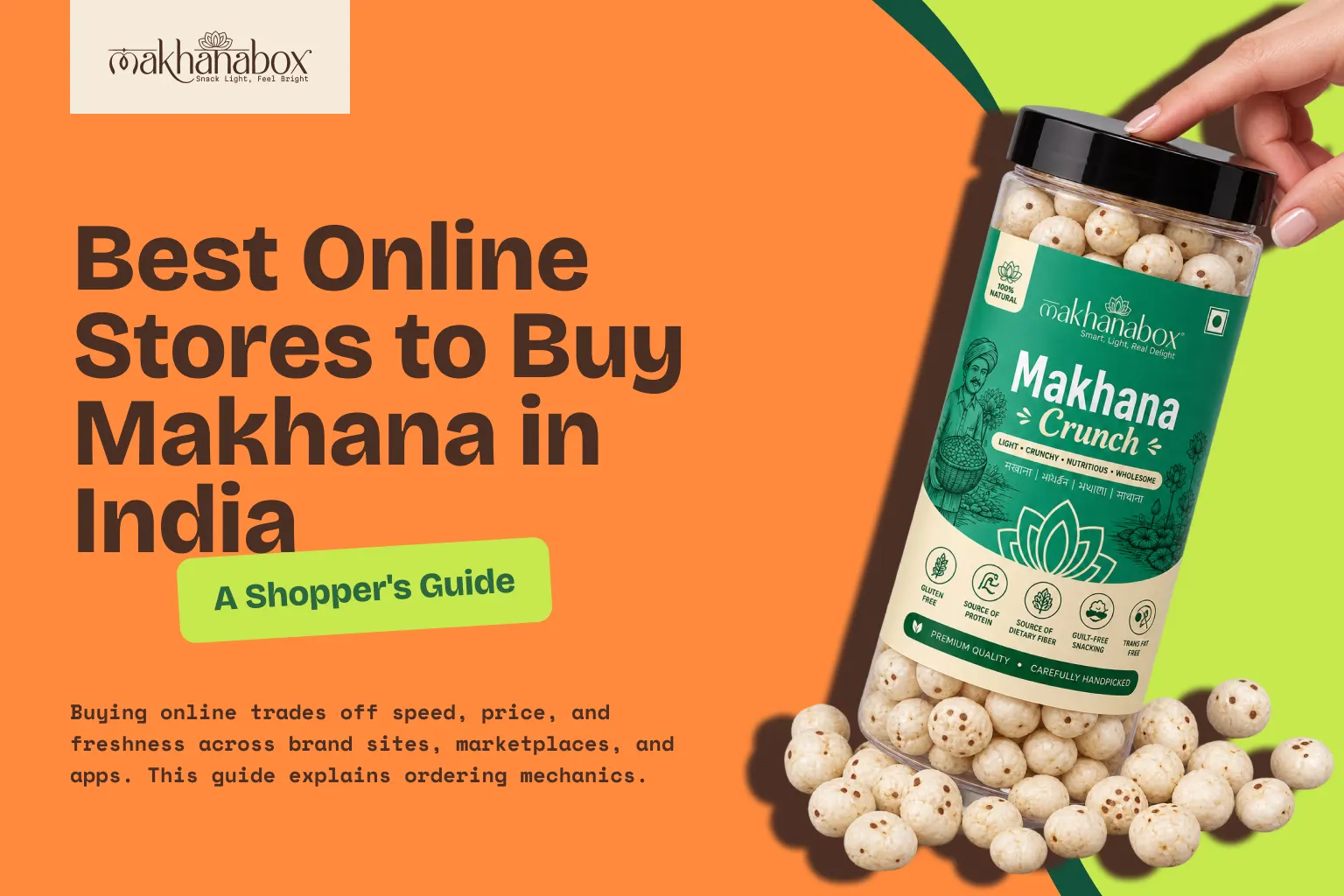
You can buy makhana online through a brand's own website, a general marketplace like Amazon or Flipkart, quick-commerce apps, or local specialty grocers with online ordering — and each of those channels trades off freshness, delivery speed and price differently. This is a guide to the shopping mechanics: which channel suits which need, and what to actually check before you order. For evaluating the product itself once it arrives — ingredients, grade, freshness signals, FSSAI licensing — see our separate buyer's guide to choosing a good makhana brand; we won't repeat that checklist here.
Direct from a brand's own website
Buying straight from a maker's own site usually means the stock you receive was roasted closer to your order date, rather than sitting in a large marketplace warehouse for an unknown length of time — freshness genuinely matters for a product that loses crunch over weeks. It also usually means direct access to customer support if something arrives wrong, without a marketplace's return process in between. The trade-off is that you're ordering from one seller at a time rather than comparing several side by side in one place. (We're one of these ourselves, so take that as disclosed context, not a neutral aside.)
General marketplaces (Amazon, Flipkart, and similar)
Marketplaces make it easy to compare several brands' pricing and reviews in one place, and delivery is often faster thanks to established logistics networks. The trade-off is stock turnover: a listing can sit in a fulfilment warehouse for a while before it ships to you, which matters more for a food product that's meant to be eaten reasonably fresh than it would for, say, a durable good. If you go this route, checking the "date of manufacture" or "best before" field specifically — not just the star rating — is worth the extra few seconds.
Quick-commerce apps (Blinkit, Zepto, Instamart, and similar)
Genuinely convenient for a same-day top-up when you're out and don't want to wait. The trade-off is that these platforms typically hold pre-packed inventory in local dark stores rather than fresh-roasted batches made to order, so it's a reasonable choice for convenience rather than the freshest possible option. Fine for a quick restock; less ideal for a first order or a bulk purchase where freshness and value matter more.
Local specialty stores and kiranas with online ordering
Smaller local sellers sometimes offer the freshest stock of all, particularly if they're roasting or sourcing in smaller batches themselves, and you can often ask direct questions about sourcing before buying. The trade-off is more variable quality and consistency between sellers, and less standardised packaging or labelling than a registered brand would typically provide — so the product-quality checklist (FSSAI licence, ingredient list, stated grade) matters even more here, not less.
What to check before you place any online makhana order
A few things specific to buying makhana online, as opposed to buying it in person: whether the packaging is described as crush-resistant, since makhana is genuinely fragile and can arrive broken in a soft pouch shipped without padding; the seller's return or replacement policy for damaged or stale product, since food returns work differently from most e-commerce categories; whether cash on delivery is available if you'd rather not prepay an unfamiliar seller; and recent reviews specifically, since a strong overall star rating can be carried by old reviews that don't reflect current stock or service.
How to actually read "organic" claims
"Organic" gets used fairly loosely in Indian snack marketing, and formal organic certification specifically for makhana is not yet a widespread, standardised claim the way it is for some other food categories. If a seller says "organic," ask for the actual certification body and number (India Organic/NPOP certification is the relevant Indian standard) rather than taking the word at face value — a specific, checkable number is a real signal; the word alone, printed on packaging with nothing behind it, isn't. We've taken the same approach with our own certifications: we'd rather show nothing than show an unverified claim.
Is a cheap deal a red flag?
Not automatically, but a price well below the typical range for a stated grade is worth a second look rather than an instant "yes." It can reflect an older batch nearing its freshness window, a smaller grade sold without clearly stating it, or seasoning padded with cheaper fillers to cut cost. Our price guide walks through what genuinely moves makhana pricing, grade by grade, if you want a reference point before comparing deals.
Frequently asked questions
What's the best way to buy makhana online — marketplace or brand website? It depends what you're optimising for. A brand's own website usually gets you fresher stock (roasted closer to your order) and direct customer support if something's wrong. A large marketplace usually gets you faster delivery and easier price comparison, but stock can sit in a warehouse longer before it reaches you. Neither is universally "best" — it's a genuine trade-off.
Is quick-commerce (Blinkit, Zepto, Instamart) good for buying makhana? It's convenient for a same-day top-up, but quick-commerce dark stores generally hold pre-packed stock rather than fresh-roasted batches, so it's a reasonable option for convenience, not necessarily the freshest one. For a first-time or bulk order, a direct brand order is usually the better bet.
How do I know if makhana is genuinely organic? Ask for an actual certification number (from a recognised body like India Organic/NPOP), not just the word "organic" on the packaging. Formal organic certification specifically for makhana is not yet a widespread standard in India, so a specific, checkable number is a meaningfully stronger signal than the word alone.
What should I check before placing an online makhana order? Whether the packaging is described as crush-resistant (makhana is genuinely fragile in transit), the seller's return or replacement policy for damaged or stale product, whether cash on delivery is available if you'd rather not prepay a new seller, and recent reviews specifically — not just the overall star rating, which can be skewed by old reviews.
Are cheap makhana deals online usually a red flag? Not automatically, but a price well below typical market rate for the stated grade is worth a second look — it can mean an older batch, a smaller grade than advertised, or seasoning padded with cheaper fillers. Our own price guide covers what genuinely moves makhana's cost up or down.
About Makhana Box
We sell directly, which we've disclosed above rather than pretending to be a neutral outside voice — but the checklist in this article applies whichever channel you actually order through. See our own flavours and raw grades, or just message us with questions before you buy anywhere. Reach us anytime:
- Phone: +91 91559 97784
- Email: sales@makhanabox.com
This article reflects general shopping guidance based on common marketplace patterns, not a certification or endorsement of any specific platform or seller.