
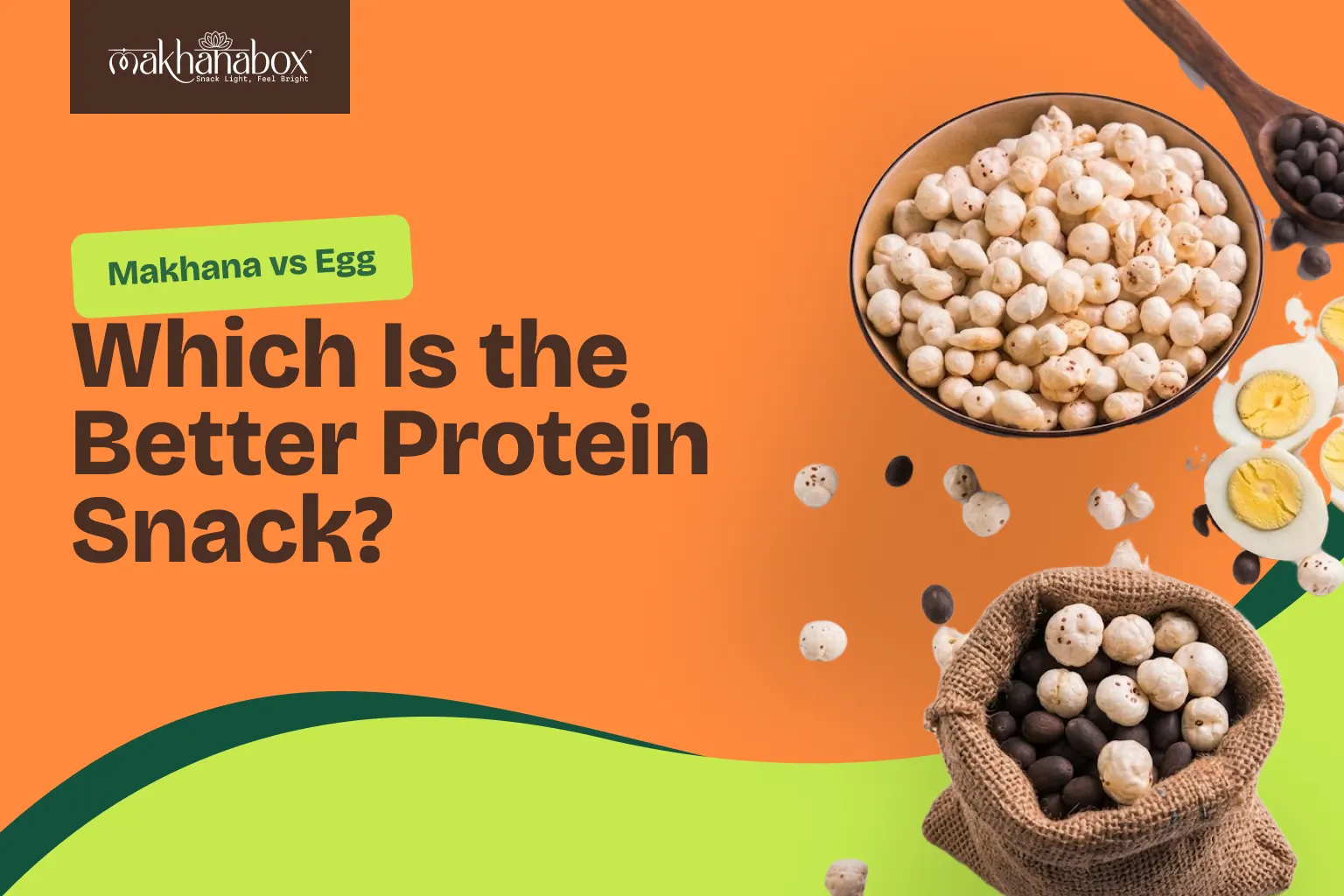
Neither wins outright — they're genuinely different foods doing different jobs. Egg beats makhana clearly on protein quantity and quality, and costs a fraction as much per gram of protein. Makhana beats egg on fibre, magnesium, and being cholesterol-free and fully plant-based. If you came here for a single winner, the honest answer is "it depends what you're optimising for" — here's the actual comparison so you can decide for yourself.
Protein: egg wins on quantity
Per 100g, egg carries around 12.6g of protein against makhana's roughly 9.7g — egg ahead, but not by a huge margin. The gap widens at realistic serving sizes: one large egg (about 50g) delivers roughly 6.3g of protein, while a typical 30g makhana snack portion delivers closer to 3g. If your goal on a given day is maximum protein from a small serving, egg is the clearer choice.
Protein quality: egg is the reference standard
This is worth being precise about rather than glossing over. Egg protein is considered "complete" — it contains all essential amino acids in proportions the body uses efficiently — and is commonly used as a reference point other proteins get measured against. Makhana's protein is real and useful, but it's lower in one specific essential amino acid (lysine), and while some research has estimated its amino acid profile is reasonably good compared to certain other plant sources, no official protein-quality score (like PDCAAS or DIAAS) has been published for makhana specifically, so we're not going to manufacture one just to make a tidier comparison.
Cost per gram of protein: egg, by a wide margin
At typical Indian market pricing, egg comes out to roughly ₹1 per gram of protein, while makhana runs closer to ₹10 per gram of protein — egg is roughly ten times cheaper on this specific measure. If protein-per-rupee is genuinely your priority, this isn't a close contest. Makhana's case has to be made on other grounds, which is exactly what the rest of this comparison covers.
Cholesterol: makhana has none
A large egg carries around 186mg of cholesterol, almost entirely in the yolk — a meaningful chunk of the roughly 300mg daily reference figure some dietary guidance has historically used (current guidance on dietary cholesterol specifically has evolved, and is worth discussing with a doctor if it's a concern for you). Makhana, as a plant seed, contains zero dietary cholesterol. For anyone specifically managing cholesterol intake under medical guidance, this is a genuine, meaningful difference, not a marketing footnote.
Where makhana pulls ahead: fibre and minerals
Egg contains essentially no dietary fibre. Makhana carries a meaningful amount — roughly 3.5g per 100g roasted, considerably more raw — plus a genuinely useful magnesium content (see our full vitamin & mineral breakdown). Fibre is one of the two nutrients most consistently linked to feeling satisfied after eating, alongside protein — so a handful of makhana can feel more filling than its protein number alone would suggest.
Where egg pulls ahead: B12, vitamin D, and choline
This is the part a plant-food comparison shouldn't skip. Eggs are a genuine source of vitamin B12, vitamin D and choline — nutrients that are difficult to get from plant foods in general, not just from makhana specifically. If you eat eggs, this is a real nutritional advantage over an all-plant snacking pattern. If you don't eat eggs for dietary or ethical reasons, that's exactly the kind of gap a doctor or dietitian can help you cover from other sources rather than something makhana or any other single plant food can fully replace on its own.
The practical difference: what each is actually for
Egg is a whole food usually eaten as part of a cooked meal — boiled, fried, scrambled — and needs refrigeration and preparation. Makhana is shelf-stable, needs no refrigeration or cooking, and travels as a ready-to-eat snack straight from the pouch. For a genuine on-the-go snack occasion, that practicality difference often matters more than the nutrition table. They're not really competing for the same moment in your day as often as the comparison implies.
Frequently asked questions
Which has more protein, egg or makhana? Per realistic serving, egg wins clearly — one large egg (about 50g) has roughly 6.3g of protein, versus roughly 3g in a 30g makhana snack portion. Per 100g the gap is smaller (about 12.6g for egg vs 9.7g for makhana), but people rarely eat 100g of either in one sitting.
Is egg protein better quality than makhana protein? By the standard measures, yes. Egg is considered a "complete" protein and is the reference standard many protein-quality scales are built around. Makhana's protein is genuinely useful but lower in one specific amino acid (lysine), and no official quality score (like PDCAAS or DIAAS) has been published for it, so we won't invent one.
Which is cheaper per gram of protein, egg or makhana? Egg, by a wide margin — roughly ten times cheaper per gram of protein at typical Indian market prices for both. If protein-per-rupee is your main goal, egg wins decisively. Makhana's value proposition is elsewhere: fibre, minerals, and being plant-based.
Does makhana have cholesterol like eggs do? No. Makhana is a plant seed and contains zero dietary cholesterol. A single large egg carries around 186mg of cholesterol, nearly two-thirds of the commonly cited daily reference amount, almost entirely concentrated in the yolk.
Is makhana a good substitute for eggs? As a snack, yes, for anyone who's vegetarian, vegan, or simply doesn't want cholesterol or animal protein — it offers real fibre and minerals eggs don't. As a nutritional substitute specifically for egg's complete protein, B12 and vitamin D, no single plant food fully replaces those, and that's worth knowing rather than glossing over.
About Makhana Box
We make the makhana side of this comparison, so take our framing with that in mind — but every number above is one we'd stand behind if you checked it yourself. Browse our six flavours or the full nutrition breakdown. Reach us anytime:
- Phone: +91 91559 97784
- Email: sales@makhanabox.com
This article is for general information and is not medical or nutritional advice. If you have a health condition, please consult a qualified professional.