
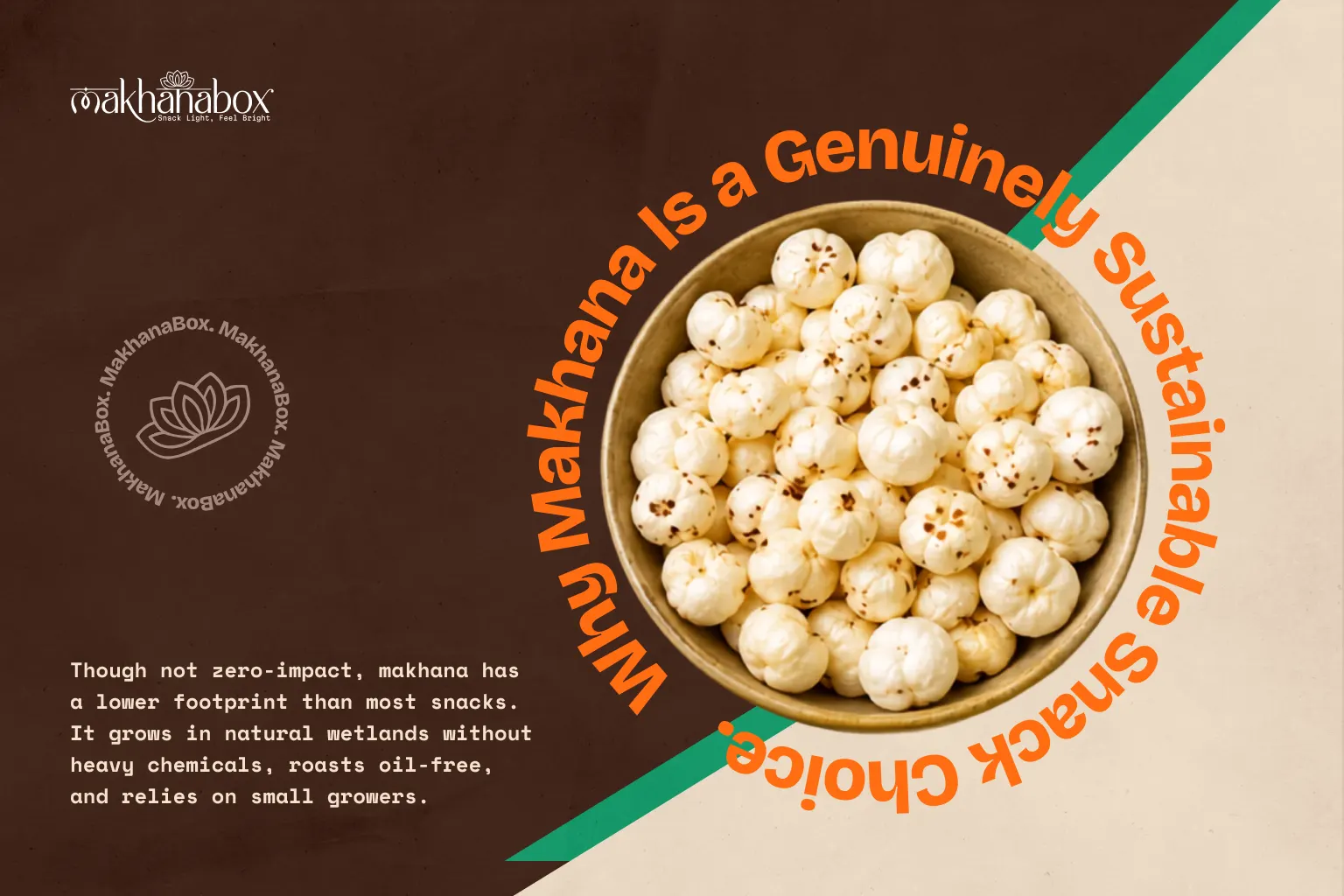
Makhana isn't a zero-footprint miracle food, but it is meaningfully lower-impact than a lot of packaged snacks in a few concrete, specific ways: it grows in natural wetland ponds without heavy irrigation or chemical inputs, it's roasted with no frying oil at all, and much of its supply chain still runs through small growers rather than industrial monoculture. Here's what that actually means, and where the claim stops.
A crop that uses water that's already there
Most row crops need water brought to them — irrigation channels, borewells, pumps running on a schedule. Makhana grows differently: it's cultivated in ponds and natural wetlands (locally called chaurs) that are already wet, filled by monsoon rainfall and the region's river systems rather than water diverted specifically to feed the crop. That's a genuinely different relationship with water than a lot of conventional agriculture has, even though the plant itself is thirsty by nature and needs standing water for most of its growing cycle. The distinction worth holding onto is "doesn't require new irrigation infrastructure," not "uses no water" — it uses plenty, just water the wetland was already holding.
It's also worth being fair about the flip side: because it depends on natural wetland conditions rather than engineered irrigation, makhana can't simply be planted anywhere water is scarce the way some irrigated crops can. Its low-input profile is tied to a specific kind of geography, not a universal trait of the plant.
Wetland ponds instead of cleared, chemical-dependent fields
Because makhana grows in existing ponds and wetlands rather than tilled dryland, cultivating it doesn't generally involve clearing new land or the kind of intensive fertiliser and pesticide programs common to a lot of row-crop farming. The ponds themselves are often long-standing features of the landscape, worked season after season rather than newly carved out. That's a real, structural difference from monoculture row-cropping — it doesn't mean makhana farming has zero inputs of any kind, but the baseline is a naturally occurring ecosystem being worked with, not reshaped from scratch.
No frying oil, no fry-oil waste
On the processing side, the clearest sustainability point is also the simplest one: makhana is dry-roasted, not fried. That matters for two concrete reasons. First, it means no cooking oil is consumed in the roasting step itself — compare that to any fried snack, where oil is a continuous input that has to be sourced, heated, replaced, and eventually disposed of, often at real volume in commercial frying operations. Second, it sidesteps the waste-oil disposal question entirely, which is a genuine environmental headache at scale — used cooking oil that isn't handled properly is a real pollution source. Dry-roasting still uses energy (heat doesn't come from nowhere), so this isn't a zero-energy process — but removing the oil input and its disposal is a specific, real advantage over any fried snack category.
Small-batch growers, not industrial monoculture
A large share of the makhana supply chain, including ours, runs through small-batch growers and processors working ponds in Bihar's wetland belt — often the same ponds their families have worked for generations, using hand-harvesting methods that haven't been mechanised. That's structurally different from the industrial monoculture model behind a lot of commodity snack ingredients, where a handful of large operations supply enormous volumes through heavily mechanised, chemical-input-intensive farming. Buying makhana from a brand that sources directly from this belt puts money more directly into those small grower livelihoods than buying from a supply chain with several anonymous middlemen would. That's a genuine, if modest and hard-to-quantify-precisely, community benefit — not a marketing abstraction.
Where we won't overstate it
It would be easy to round all of the above up into "the most sustainable snack you can buy" — we're not going to do that, because it isn't a claim we can actually back with real measurement. We don't have carbon-footprint numbers for makhana versus other snacks, and we're not aware of anyone who does with real rigor. Packaging, transport from Bihar to wherever you are, and the roasting energy itself all carry some footprint, same as any packaged food. The honest framing is "meaningfully lower-impact in several specific, real ways" — natural wetland growing, no frying oil, small-grower sourcing — not an absolute sustainability crown over every other snack on a shelf. We'd rather make a claim we can stand behind than a bigger one we can't.
Frequently asked questions
Is makhana an environmentally friendly snack? It's meaningfully lower-impact in several concrete ways rather than an absolute environmental winner: it grows in natural wetland ponds without the intensive irrigation and chemical inputs many row crops need, and it's dry-roasted rather than fried, avoiding cooking-oil use and disposal. That's a real set of advantages, not a claim of zero footprint.
Does growing makhana require a lot of water? It grows in standing water, but largely in ponds and natural wetlands that are already wet from monsoon flooding and river systems, rather than water pumped or diverted specifically for irrigation the way many dryland crops need. That's a genuinely different water relationship than most row-crop farming, even though the plant itself needs sustained water to grow.
Is dry-roasted makhana better for the environment than fried snacks? In the specific sense of avoiding frying oil, yes — dry-roasting uses direct heat rather than large volumes of cooking oil, which cuts out the oil itself along with the energy and waste-disposal questions that come with using and discarding fry oil at scale. It doesn't make roasting a zero-energy process; heat is still heat.
Does buying makhana support small farmers? Much of the makhana supply chain runs through small-batch growers and processors in Bihar's wetland belt working ponds their families have often worked for generations, rather than large industrial monoculture operations. Buying from brands that source directly from that belt supports those livelihoods more directly than buying from an anonymous bulk commodity supplier would.
Is makhana a zero-waste or carbon-neutral snack? No, and it shouldn't be marketed that way. It has real, concrete advantages in specific parts of its production — low-input growing and oil-free roasting chief among them — but packaging, transport, and processing all still carry some footprint. "Meaningfully lower-impact in several ways" is the honest claim, not "zero impact."
About Makhana Box
We source directly from growers in Bihar's wetland belt and dry-roast every batch ourselves in Patna — no frying, no anonymous middlemen. You can read the fuller sourcing story on our About page, and see exactly what happens between the pond and your pack on our how we process page. Reach us anytime:
- Phone: +91 91559 97784
- Email: sales@makhanabox.com
This article reflects general, good-faith observations about makhana's production, not a certified environmental audit or lifecycle assessment.